

Tulsi / Holy Basil: Ocimum sanctum
By Steph Zabel
Herbalist, Ethnobotanist and Educator
For thousands of years tulsi has been considered a sacred herb. Also called holy basil and “the elixir of life” it originated in India, where it became an important herb of Ayurvedic medicine, and was sacred to the Hindu god Vishnu. Amongst Ayurvedic practitioners it is known as a rayasana plant, which is a special group of herbs said to promote longevity and perfect health.
Tulsi’s popularity has now spread throughout the world and Western herbalists have also fallen in love with it. Traditionally used for a variety of ills ranging from respiratory problems to exhaustion to digestive issues, it is a remarkable plant for human health.
By Steph Zabel
Herbalist, Ethnobotanist and Educator
For thousands of years tulsi has been considered a sacred herb. Also called holy basil and “the elixir of life” it originated in India, where it became an important herb of Ayurvedic medicine, and was sacred to the Hindu god Vishnu. Amongst Ayurvedic practitioners it is known as a rayasana plant, which is a special group of herbs said to promote longevity and perfect health.
Tulsi’s popularity has now spread throughout the world and Western herbalists have also fallen in love with it. Traditionally used for a variety of ills ranging from respiratory problems to exhaustion to digestive issues, it is a remarkable plant for human health.

Tulsi is incredibly aromatic - both spicy and pungent like culinary basil (its close cousin), but also with hints of sweetness and clove to it. All upper portions of the plant – leaves, stems, flowers, and seed heads – hold this aromatic property. Even a slight touch of the fresh plant will release its beautiful scent into the air.
Modern herbalists use tulsi as an adaptogen, which is a type of herb that helps one to adapt to and overcome everyday stress. It can calm an over-active mind, help one feel more grounded during times of overwhelm, and is said to “gladden the heart.” Used consistently it can also increase energy and endurance.
It is also a lovely relaxing nervine, and a calming, centering herb useful for an anxious mind. Personally I find it to be very comforting and grounding when I feel scattered, or my to-do list seems endless.
In going back to Ayurveda’s use of tulsi as a rayasana (rejuvenative) herb, holy basil can help move an individual towards whole health and vitality, acting on many systems of the body. Due to its stimulating essential oil content it will increase and support digestion. Traditionally it was also used to protect against disease by supporting the immune system. As an antibacterial plant, it is useful herb for colds and respiratory infections and also helps to clear away excess mucous.
You may see a few different varieties of tulsi available, including rama, vana and krishna tulsi. Experiment to see which one you like best as they all have slightly different scents and tastes. Krishna tulsi has the most intense and pungent flavor. My favorite, however, is the mellow rama variety, which also happens to be the one most commonly cultivated and easily found.
HOW TO USE:
To make an aromatic cup of tulsi tea steep up to 1 Tblsp. of the dried leaf in one cup of water for 10 minutes, covered. If you are fortunate enough to have fresh tulsi leaf on hand, use twice this amount per cup of water. Tulsi also makes a wonderful iced tea during the summer months – keep a pitcher in the fridge to drink throughout the day.
Note: Tulsi is not recommended for those trying to conceive due to possible anti-fertility effects with consistent, long-term use.
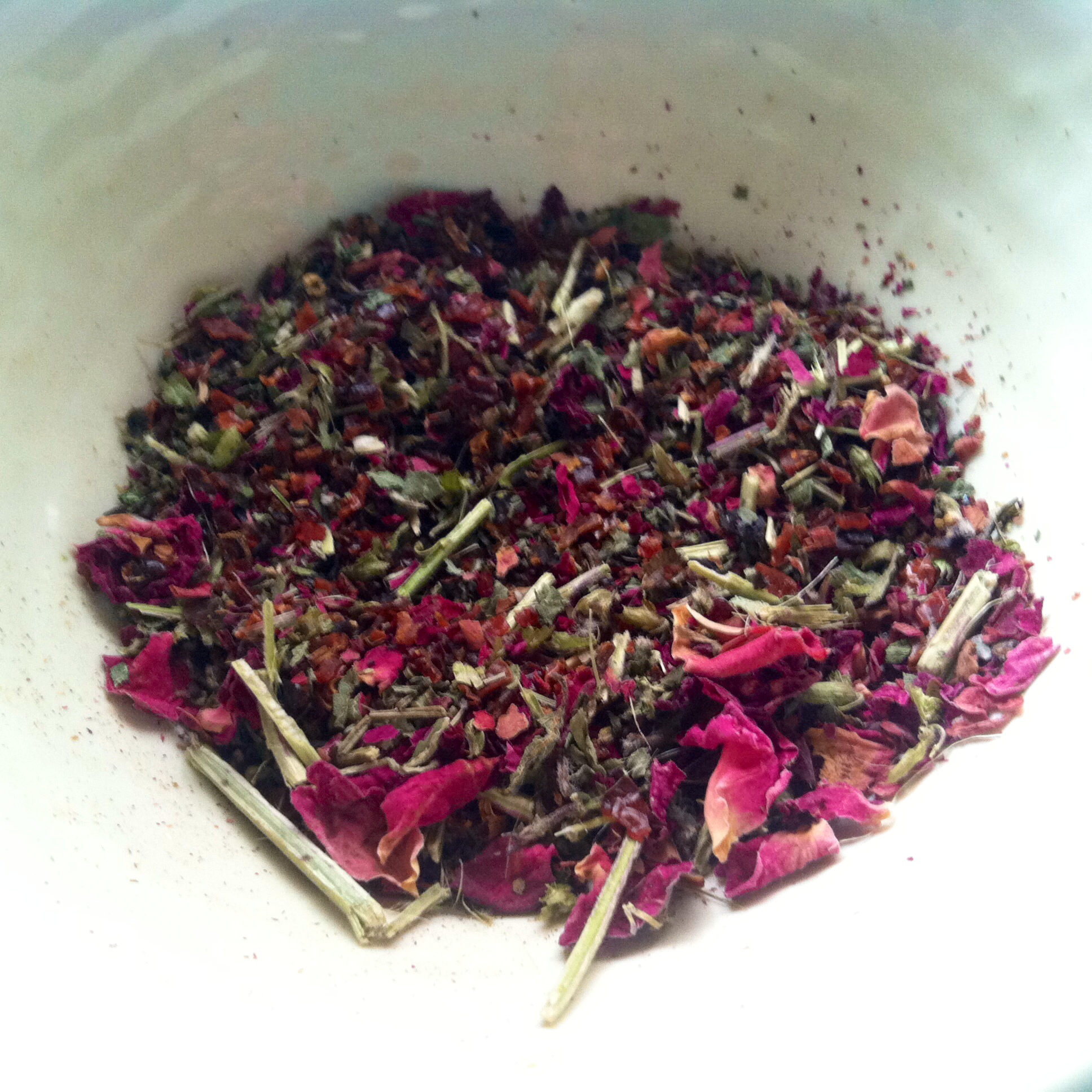
RECIPE: Winter Tulsi-Rose Tea
Tulsi and rose are wonderful companions. Drink this tea when you have the winter blues or need a little pick-me-up.
Mix together:
2 Tblsp. Tulsi
1 Tblsp. Rosehips
½ Tblsp. Rose Petals
Steep up to 1 Tblsp. of the blend in 1 cup of hot water for at least 10 minutes, then strain out the herbs. Add honey if desired.
Steph Zabel is an herbalist and educator based in Somerville, MA who helps urban dwellers connect with the plant world. She teaches herbal classes, is available for individual wellness sessions, and is also the founder of HERBSTALK, a community herbal conference. Learn more about her work at: www.flowerfolkherbs.com and www.herbstalk.org.
References:
Winston, D. and Maimes, S. Adaptogens: Herbs for Strength, Stamina, and Stress Relief. Rochester, VaA Healing Arts Press. 2007.
http://www.gaiaherbs.com/uploads/1596_HPR_HolyBasil_ResearchPaper-1371567034.pdf
http://www.uofmhealth.org/health-library/hn-4597000
http://www.drweil.com/drw/u/QAA346157/holy-basil-to-combat-stress.html
This Web site — Herbs and Botanicals — is for general health information only. This Web site is not to be used as a substitute for medical advice, diagnosis or treatment of any health condition or problem. Users of this Web site should not rely on information provided on this Web site for their own health problems. Any questions regarding your own health should be addressed to your own physician or other healthcare provider.
Maribeth's Peaceful Heart Tea
:: to uplift mood & spirit ::
Maribeth, our herbalist-in-training on staff made up this delicious tea blend to lift the heart and bring light to the spirit during these cold, dark days of our New England winter.
A good mood can often support our immunity, bringing us up out of the dark and helping us to find peace in hibernating. This tea has helped to lighten the weight of this deep winter and remind me of the beauty of slowing down to rest. Also great on the go to calm the anxieties and stressors of traveling through a snow-blanketed city as we soldier the last weeks of winter.
Holy Basil to relax mind and body and bring positivity and warmth.
Hawthorn Leaf & Flower to bring peace to the heart and calm to the nerves
Rose Petals to remind us to love our experiences, each other, and ourselves
Calendula Flowers to remind us of the warm sun, illuminate the darkness, and aid a sluggish system
Rosemary to rejuvenate, clear, and uplift our spirit

I enjoy this tea all day long as winter continues to visit us here in the North East. The ritual of making tea itself has a calming, soothing effect and allows me to slow down as winter intends. This blend of herbs not only works on the emotional body, but supports digestion, our lymphatic system, and strengthens our blood during these more sluggish months.
Grab a pre-made package of Peaceful Heart Tea at Cambridge Naturals - or make your own! Feel free to add any other of your favorite uplifting herbs to this recipe:
1/4 cup Hawthorn Leaf & Flower
1/4 cup Holy Basil
3 Tbsp. Rose Petals,
2 Tbsp. Calendula Flowers
1 Tbsp. Rosemary
Use 1 tsp. to 1 tbsp. of this blend to your mug of hot water. Steep 10 - 15 minutes, covered. Strain, breathe deep, sip, and relax. Add raw, local honey if desired for an added immune and spirit boost.
Cheers to happiness and good health!
Calling all curly girls!!
Sarah, our Body Care Department Lead, has an amazing head of curly red hair! She often gets complimented on her lovely locks, and asked for the details of her hair care regimen. She put together this entertaining and comprehensive guide for all the curly girls out there - tried and true ways to maintain that gorgeous mane!

Sarah's curls on display during the first winter snow!
If you are a fellow curly haired comrade, you can appreciate the woes of curly hair... both loving your curls and learning how to maintain and style them. It took me nearly 20 years to fully embrace my curls and almost 10 more to learn how to perfect the styling and maintenance of them. With the help of an amazing book, called Curly Girl: The Handbook, MopTop Haircare products, and a microfiber towel, I don't think my curls have ever looked so good, in my humble opinion. So if you want to learn to love your curls and establish a successful styling routine, here's what you oughta do...
Read the book Curly Girl: The Handbook to refresh your attitude and hair-outlook. This book is great for that, as well as helping you to understand how curly hair works and the type of curls you have. It's also crucial in learning which hair care products to avoid, and most importantly how to care for and style your curly hair. And after you do this...
MopTop Haircare is "curly girl" friendly, meaning it does not contain sulfates, silicone, and parabens that are harsh and strip your hair of beneficial oils. Curly hair is more delicate and drier than other hair types, so you must treat it tenderly! At the beginning of my new routine, I used the MopTop Haircare Clarifying Rescue Treatment. This is just a once in a while reset/detox for your hair, especially if you were using mainstream hair care products previously. It makes your hair feel fresh and rejuvenated without feeling dry or too squeaky clean.

Then, you shampoo! I use the MopTop Haircare Gentle Shampoo. Since using this shampoo, I've found that I don't need to wash as frequently, as I think it balances my scalp oil production. It's not drying or harsh on my curls either. And it smells very nice! If you're switching from mainstream shampoo, it will feel a little different because it doesn't lather a ton or leave your hair feeling squeaky clean, but that's how it's supposed to be!
Next, I condition with the MopTop Haircare Light Conditioner. It's important to be extra gentle when shampooing and conditioning. The Curly Girl Handbook illustrates how to properly shampoo and condition, but you basically want to comb it through with your fingers, scrunch, and then rinse as you scrunch. The Light Conditioner makes your hair so soft but not heavy and you really can run your fingers through your hair!
I apply the Medium Hold Gel by MopTop while my hair is still damp, smoothing over my hair and scrunching upward. No toweling yet! As per the Curly Girl method, this helps to define your curls and lock in the moisture. I like the MopTop gel because it provides definition and hold to my curls but doesn't make them crunchy or dry.
Finally, the 3rd key player: the Microfiber Towel by Earth Therapeutics. This towel has been miraculous. Cup your hair with the towel, scrunch, and squeeze. The towel soaks so much water and exponentially speeds drying and decreases frizz!
Occasionally in the winter, I will use a hair dryer with diffuser attachment if I don't have time to wait for my hair to dry. The diffuser attachment is important, as it diffuses the harsh heat and helps to maintain hair definition.
And waa-laa!! A head of hair that's supercalifragilisticexpialidocious!
The CN Staff Playlist: Neptune Edition
Our staff are stuck at home today once again as the store is closed due to Winter Storm Neptune. Cabin fever is starting to set in and we're seeking ways to stay connected. So we created a Cambridge Naturals Staff Playlist: Neptune Edition, for our listening pleasure and yours! This is an accumulation of some of our favorite songs to lift our spirits out of the wintertime doldrums. We hope you enjoy!

♫ Listen here.
Valentines Weekend Survival Kit

Looks like we're expecting another foot of snow this holiday weekend, along with gusty winds and other blizzard-esque conditions. Joy!!!
But that's no reason to miss out on celebrating. We put together a Valentines Weekend Survival kit to help you make it through in style.
Fill the bathtub... with this delightful Simple Bathing Milk from Little Barn Apothecary. With essential oils of clove and orange, it'll warm your exhausted snow-shoveling limbs and soothe your mind with thoughts of spring.
There's snow reason to panic... but a delicious mug of Magnesium Calm anti-stress formula can help take the edge off! Mix one serving into lukewarm water. Or, put a few droppers of Urban Moonshine's Chocolate Love Tonic into your drink of choice to encourage a more romantic mood. We recommend it in hot chocolate or a cocktail!
No one can hold a candle to the one you love... unless they're holding a Rose Garden Candle from local company Thesis Beauty. These amber-glass candles glow bright for hours, keeping the flame of passion burning even after your power goes out from the storm. We suggest lighting a few candles, turning up the (battery-operated) stereo, breaking into a bar of My Cherry Baby Chocolate from Theo, and opening a bottle of Plantlife Enhance Romance Massage Oil to fully set the mood.
If the weather is really driving you nuts... fill your bowl with guacamole instead! This tasty guac from local company Chica de Gallo is the perfect healthy-fat food to keep you satiated through the long, wintry night. Pair with Mary's Gone Crackers for a delicious snack, and share it over candle-light with the one you love.
BOOK REVIEW: Broth, Nourishing Broth
Nourishing Broth: an Old-fashioned Remedy for the Modern World
By Sally Fallon Morell and Kaayla T. Daniel
Reviewed by Rosalind Michahelles
This book tells you first why you should drink broth and then how to make it. The “why” occupies parts one and two of the book, starting with the nutrition science on boiling bones, tendons, ligaments and the other remains—whether fowl, fish, or meat -- after we have eaten. There is a good deal of complexity here but we can boil it down to gelatin, collagen, and cartilage. All three are important elements in broth and stock, defined variously as including bits of meat and vegetable or not. Stock, being the strained version, is used as a base for gravy and other sauces, especially after deducing or concentrating it.
Nourishing Broth: an Old-fashioned Remedy for the Modern World
By Sally Fallon Morell and Kaayla T. Daniel
Grand Central Publishing, 2014
Reviewed by Rosalind Michahelles

This book tells you first why you should drink broth and then how to make it. The “why” occupies parts one and two of the book, starting with the nutrition science on boiling bones, tendons, ligaments and the other remains—whether fowl, fish, or meat -- after we have eaten. There is a good deal of complexity here but we can boil it down to gelatin, collagen, and cartilage. All three are important elements in broth and stock, defined variously as including bits of meat and vegetable or not. Stock, being the strained version, is used as a base for gravy and other sauces, especially after deducing or concentrating it.
Gelatin is made from collagen. The commercially available powdered form is a handy additive to make food both more digestible and also higher in protein, gelatin being 85-90% protein. Unfortunately, most of us first met it in the artificially sweetened and colored product Jell-O! Gelatin is what gives Jell-O its wobble. From a medical point of view, gelatin can be important for its “sparing effect” on protein such that the body is less likely to cannibalize protein from its own body tissue – hence the effectiveness of traditional meat broth during illness and convalescence.
To get gelatin from collagen you cook it. In our own bodies, collagen accounts for over a quarter of our protein, being found in skin, bones, membranes, blood vessel walls, organs, and, well, just about everywhere. The authors maintain that, since the body builds collagen as part of the healing process, we should drink broth instead of taking NSAID pain killers which block inflammation. In other words, accept pain from inflammation in the name of healing – don’t thwart your immune system’s defenses.
If you know about cartilage, it may be from experiencing joint injury or osteoarthritis. (Cartilage is what we call gristle when it’s our own joints, but ‘gristle’ when we find it in our dinner.) In any case, it is one of the healing elements in broth. There has been research into the effectiveness of consuming cartilage – via broth – to repair damaged or thinning cartilage. The book goes into some detail about the proteins which are involved in maintaining and repairing cartilage and other tissues and then addresses how various ailments can be alleviated by consuming broth and stock. Specifically, besides osteoarthritis, they are: rheumatoid arthritis, scleroderma, psoriasis, wound healing, infectious diseases, digestive disorders, cancer, and mental illness. If some of the claims seem far-fetched, there is nonetheless no harm in drinking broth, so why not?
Certainly, one reason why not could be not knowing how to prepare broth and stock or not trusting commercial offerings. So the last 150 pages of the book tell you how from the simplest boiling bones in water to more ambitious fare. And here’s a modern twist to an age old practice: think of stock as a gluten-free sauce thickener! You will find lots of recipes for soups and stews and plenty to keep a slow cooker filled and occupied – while keeping you, also, full and occupied. This is both a very interesting and very useful book.
Calendula: Blossoms of the Sun Calendula officinalis
By Steph Zabel
Herbalist, Ethnobotanist and Educator
Calendula is a quintessential summertime herb – its flowering reaches its peak during the warmest months, and its orange and yellow blossoms look like small suns. Which is exactly why calendula is such an agreeable herb for this time of year, when we all could do with a bit more sunshine, warmth, and color amidst our dark New England days. In the depths of winter, calendula flowers are a saving grace with their brightly colored petals, and their virtues steeped in hot cups of tea.
By Steph Zabel
Herbalist, Ethnobotanist and Educator
Calendula is a quintessential summertime herb – its flowering reaches its peak during the warmest months, and its orange and yellow blossoms look like small suns. Which is exactly why calendula is such an agreeable herb for this time of year, when we all could do with a bit more sunshine, warmth, and color amidst our dark New England days. In the depths of winter, calendula flowers are a saving grace with their brightly colored petals, and their virtues steeped in hot cups of tea.
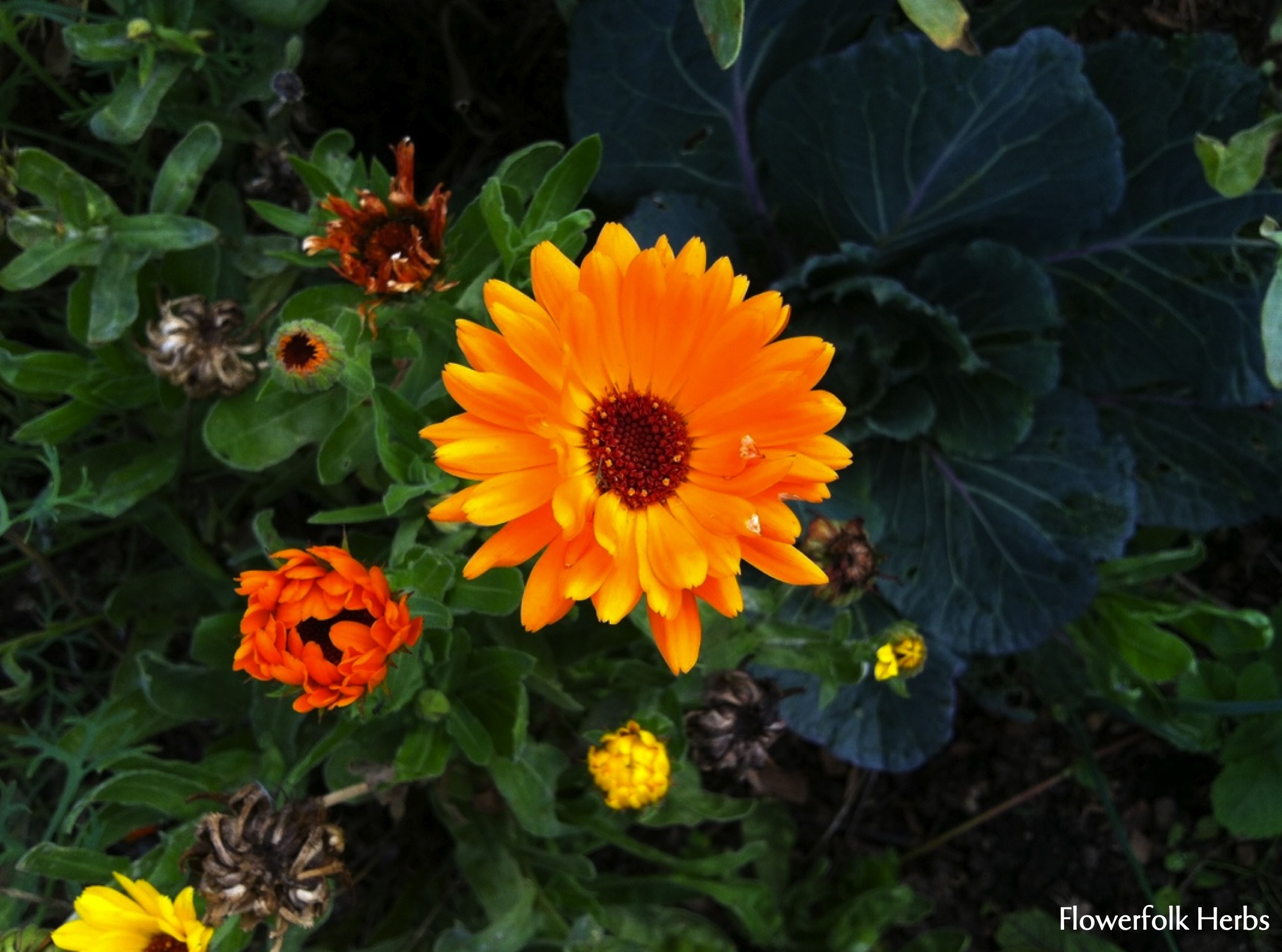
Like many of our commonly used herbs, Calendula officinalis originates from the Mediterranean region. But due to its hardy temperament, abundant seeding habits, and lovely flowers, it is grown wherever there are gardeners and herbalists familiar with its qualities. Its genus name Calendula relates to its prolific blooming habits, where in the right climate, could produce flowers in every calendar month. Although it is technically an annual plant, this past fall I brought my potted calendula inside to continue its growth under grow-lights, and it has continued to amaze me with its vigor. It has put on new growth and bloomed throughout the whole winter, showing no signs of letting up.
The second part of its scientific name, officinalis, denotes that it is a plant that has an established history of use in herbal medicine. Indeed, calendula is still known and loved for its healing qualities by the modern herbalist. As a lymphatic herb, it stimulates lymphatic drainage, and increases the elimination of waste products from the body. A healthy lymphatic system corresponds to a strong immune system, which is especially important during a long winter, when we are all more prone to colds and flu. Last winter, for instance, I experienced a long-lasting cold that I just could not seem to shake. I took elderberry syrup (link to elderberry post) and rosehip tea, drank bone broths and chicken soup, and slept a lot. But this time, I felt that something else was needed… So I turned to my herb cabinet to locate some summer-dried calendula flowers and steeped them for a long while in a pot of water on my stove. I drank this dark-hued, golden tea, feeling as if it were liquid sunshine, a brew so strong it was almost bitter. My body seemed happy for it, the cold went away shortly, and indeed my mood – after a few melancholic days – lifted.
It was a ray of light during a time of sickness and the winter blues.
Calendula mixes nicely with other herbs, but I would recommend trying it on its own first. Or, you can add a handful of the flower heads to pots of soup or broth as it simmers, which is a traditional way to boost the immunity during the winter months.
Beyond its internal applications, calendula is also renowned for its use as a topical wound healer and balm for the skin. The orange petals have been shown to help wounds heal faster, and increase blood flow and oxygen to the damaged area, helping the body grow new tissue. It has been used with great success as an infused oil or salve in cases of skin inflammation and eczema. A poultice or balm of calendula petals can also help reduce the pain of insect stings and swelling.

If you are growing calendula in your garden, save the dried seeds in the fall to sow the following spring. In the summer harvest the newly-opened and vibrant flower heads and notice the sticky resin covering the calyx, where much of its medicinal goodness resides. Dry these flowers on a screen or on brown paper bags for a few days until completely dry, then store in a glass jar out of the sunlight to use throughout the autumn and winter months. It’s like bottling up the energy of the summer sun to use during darker days.
How to Use:
To make a simple Calendula tea, steep 1 Tblsp. of the dried flowers in one mug of boiled water, covered, for at least 10 minutes. Strain and drink.
To use Calendula in soups or broths, simply add a handful of the dried flower blossoms to any broth or stock that you are making and allow the petals to infuse while the broth is cooking for at least an hour. Strain and use in any soup recipe.
Please Note: Calendula is a member of the Aster (Asteraceae) plant family, which may cause allergic reactions in some people. If you are allergic to Chamomile or other Aster plants, use calendula with caution.
RECIPES:
Winter Gladness Tea
This is a perfect mid-winter blend, because it is uplifting, gently aromatic, and full of cheery colors! Sometimes I will add in other herbs such as elderberries or orange peel, but the basic recipe is below - use it as is, or get creative and adjust to your own taste.
This recipe will make 8 - 10 servings.
Blend together:
4 Tbsp. Holy Basil
2 Tbsp. Rose Petals
1 Tbsp. Hibiscus
1 Tbsp. Rosehips
1 Tbsp. Calendula
Use 1/2 - 1 Tablespoon of this tea blend per mug of hot water. Let steep at least 10 minutes, covered. Strain and add honey if desired.
Calendula & Rose Skin Salve

Adding beeswax to an infused calendula and rose oil creates a beautiful salve that can be used topically on dry, winter hands, minor cuts, or patches of eczema. If you add essential oils to your blend you can also create a wonderfully aromatic salve that makes for a lovely gift.
There are a few different methods for making infused herbal oils, but the crockpot method is my favorite and seems to produce the best oil extractions.
Ingredients:
1 cup dried calendula flowers
1 cup dried rose flowers (pink or red)
3 cups organic olive oil (or other cold-pressed oil)
~ ¾ cup beeswax pellets
essential oils
Place the dried calendula and rose petals in a small crockpot. Cover with the oil. Turn the crockpot to low and let steep for at least 4 hours. If at any point the oil starts to simmer and bubble, turn the crockpot off to allow the oil to cool down, and then turn it back on to low. I often do this over the course of 2 to 3 days, turning the crockpot on and off repeatedly, to allow for maximum extraction of the herbs without over-cooking them in the oil.
Strain out the herbs and measure the remaining infused oil. In a double boiler on the stove, mix together the oil and beeswax pellets, combining over low heat. The general rule of thumb is to use ¼ the amount of beeswax to oil, but this can be adjusted according to how soft or hard you want the final salve to be. Check for consistency by placing a spoonful of the combined oil and beeswax in the freezer – in a few minutes you will be able to check its texture; if it is too soft, add more beeswax, if it is too hard, add more oil.
Remove the mixture from the stove and add in 40 – 80 drops of your chosen essential oil(s). Carefully pour into tins or glass containers and allow to set.
Steph Zabel is an herbalist and educator based in Somerville, MA who helps urban dwellers connect with the plant world. She teaches herbal classes, is available for individual wellness sessions, and is also the founder of HERBSTALK, a community herbal conference. Learn more about her work at: www.flowerfolkherbs.com and www.herbstalk.org.
References:
Wood, Matthew. The Book of Herbal Wisdom. Berkeley, CA: North Atlantic Books, 1997.
Chevallier A. The Encyclopedia of Medicinal Plants. New York, NY: DK Publishing, 1996.
http://umm.edu/health/medical/altmed/herb/calendula
http://www.botanical.com/botanical/mgmh/m/marigo16.html
http://cms.herbalgram.org/herbalgram/issue77/article3229.html?ts=1421603612&signature=66229b7765b3346b74efb03b6d80ae33
This Web page — Herbs and Botanicals — is for general health information only. This Web site is not to be used as a substitute for medical advice, diagnosis or treatment of any health condition or problem. Users of this Web site should not rely on information provided on this Web site for their own health problems. Any questions regarding your own health should be addressed to your own physician or other healthcare provider.
Sweet gifts for the one(s) you love
Valentines is a holiday that many of us love to hate. It's hard to get wrapped up in the pink hearts and red roses and gushy songs if you're not in a romantic relationship - and it can seem a bit contrived even if you are!
But the concept of celebrating love itself is generative - meaning, the more love you put out into the world, the more it grows and grows. And giving as an act of love can be a very special thing indeed. So whether it's a friend, family member, or significant other, here are a few sweet gift ideas for the ones you love.
Valentines is a holiday that many of us love to hate. It's hard to get wrapped up in the pink hearts and red roses and gushy songs if you're not in a romantic relationship - and it can seem a bit contrived even if you are!
But the concept of celebrating love itself is generative - meaning, the more love you put out into the world, the more it grows and grows. And giving as an act of love can be a very special thing indeed. So whether it's a friend, family member, or significant other, here are a few sweet gift ideas for the ones you love.

Little Barn Apothecary's Simple Body Oil [Moon]
We recently brought in this new line of hand-crafted body care products from Little Barn Apothecary in Stone Mountain, Georgia. Their body oil is a blend of cold-pressed hemp seed, sunflower seed, and jojoba oils that create the perfect non-clogging elixir to nourish your dry skin! Their [Moon] blend incorporates essential oils of juniper, orange, basil and rose and smells intoxicatingly like a late summer evening. A wonderful gift to be used as a body moisturizer or even as a massage oil.
Urban Moonshine's Love Tonic
This delicious Chocolate Love Tonic combines the aphrodisiac powers of raw chocolate and honey with a variety of herbs and spices to kindle the flame of passion. Add a dash to your drink of choice, or add it to the frosting on a chocolate cake! Perfect for setting the romantic mood on Valentine's eve.
Shoosha Baby's Massage Oil
Shoosha Baby uses only the finest and purest organic oils infused in organic herbs for baby’s delicate skin (so natural you could eat them!). This wonderful massage oil, available in both unscented and Lavender Vanilla, makes the perfect gift for both mama and baby!
Apotheker's Chocolate
What says love more than honey-sweetened, hand-crafted, locally-made chocolate?! We can't think of anything. This delicious chocolate is made in Jamaica Plain by Russ and Shari Apotheker (really, it's their last name) with love. The perfect desert bar, or melt some down to toss on popcorn (as they did) for an incredible treat.
Savannah Bee Honey
She's as sweet as Tupelo honey
She's an angel of the first degree
She's as sweet as Tupelo honey
Just like honey from the bee
Give your loved ones the gift of pure, golden Tupelo Honey! For two weeks every spring, White (Ogeche) Tupelo Trees in the Southeastern swamps bloom with fine sunburst-shaped flowers that glisten with nectar. Savannah Bee Company Tupelo Honey has buttery undertones and a mellow, clean-finishing sweetness. It's like a thick, slow-moving river of liquid sunshine.
Stretch your way into the New Year!
It can be a challenge to transition from the hedonism of the holiday season into healthy habits in the New Year! Many people make resolutions to be healthier, more fit and more energized. Practicing yoga is a great way to ease into a more active lifestyle during these cold, dark months. Jade, our resident graphic designer extraordinaire, is also a talented yoga instructor. She put together a couple of poses that will help to stretch and strengthen your body which in turn helps to manage stress!
Baddha Konasana

This posture is a great hip opener.
Sitting with your spine straight, bring your feet together so that your heels and little toes are touching. The knees will splay out as you open your feet up like a book. If the knees are high up off the ground, don't use force to push them down. Instead just gently let the weight of your knees come down towards the ground. Continue to sit up tall, keep a neutral facial expression and breathe fully for 5-10 breaths. If your knees are close to or on the floor, after taking the 5-10 breaths sitting straight up, draw in your lower abdomen and reach your chest and chin forward exhaling as you continue to open up your feet and again, take 5-10 breaths. This will bring you deeper into the posture and give your hips more of a stretch. This posture is extremely beneficial for stimulating the abdominal organs, stretching the inner thighs, hips and knees and increasing circulation. Some traditional yoga texts state that Baddha Konasana is one of the most important postures.
Purvottanasana

This posture engages the entire body and opens up the heart.
Sitting on the floor with your legs straight in front of you and feet together, bring your hands behind you about a foot back with your fingers facing in the direction of your feet. As you inhale, press down into your hands and send your hips up as you reach your toes down towards the floor. Again, keep a neutral facial expression as well as an engaged core and let your head come back as you take 5 full breaths. On the last exhale, lower your hips down. If pushing up from the floor is too challenging to start, you can hold on to the back of a chair, again with your fingers facing your feet, knees start off bent and as you inhale, lift your hips and straighten the legs. This posture strengthens the arms, legs and wrists and gives a good stretch to the shoulders, chest and feet.
I hope you enjoy these postures and that they bring you strengthen and flexibility in the New Year!
Vitamin D - A Superstar for Winter Health Infection-Fighting Abilities For Colds and Flu
This well-known vitamin has recently become a “superstar” among our customers, their MDs and wellness experts alike. Recent research has pushed the amazing impact that Vitamin D has on our everyday health into the limelight.
A large and growing body of evidence is showing that this “sunshine vitamin” controls some 30,000 different genes in our bodies all of which play a crucial role in our health and well-being. (1)
This vitamin is naturally produced during the summertime when our skin is exposed to direct sunlight— a good reason not to overuse sunscreen. But in the northern latitudes in winter…well above the equator, where we live in Massachusetts, the rays that produce Vitamin D in our skin are long gone. In fact the sun’s rays are insufficient to produce ANY Vitamin D from October through May here in the Boston area. We Northeasters have a very short summer 4-month window to utilize Vitamin D rays from the sun….leaving us to consider Vitamin D supplements for our best health solutions!

This well-known vitamin has recently become a “superstar” among our customers, their MDs and wellness experts alike. Recent research has pushed the amazing impact that Vitamin D has on our everyday health into the limelight.
A large and growing body of evidence is showing that this “sunshine vitamin” controls some 30,000 different genes in our bodies all of which play a crucial role in our health and well-being. (1)
This vitamin is naturally produced during the summertime when our skin is exposed to direct sunlight— a good reason not to overuse sunscreen. But in the northern latitudes in winter…well above the equator, where we live in Massachusetts, the rays that produce Vitamin D in our skin are long gone. In fact the sun’s rays are insufficient to produce ANY Vitamin D from October through May here in the Boston area. We Northeasters have a very short summer 4-month window to utilize Vitamin D rays from the sun….leaving us to consider Vitamin D supplements for our best health solutions!
Vitamin D3, or cholecalciferol is the most effective form of this vitamin which is actually a group of fat-soluble prohormones produced in the body (1) through the sun exposure or naturally occurring in a very few foods: fatty fish such as mackerel, salmon, and tuna, and in small amounts in cheese, egg yolks, and beef liver (2). Vitamin D is also added to foods such as milk, orange juice, and breakfast cereals.
Important for the “winter blues,” recent research at the University of Arizona College of Medicine highlighted an “enhanced the ability of the brain cells to produce serotonin by anywhere from double to 30 times as much.” (3) Think better sleep and the ability to ward off viruses with an increase in serotonin (4, 5).
According to an article in the New England Journal of Medicine, “When the immune system is fighting pathogens …. cytokines can assist in fighting off the flu …. they also deplete one’s serotonin levels …. depressive symptoms—can accompany or follow the flu. (6)
But serotonin research isn’t all that has been discovered in recent years. Vitamin D also exhibits its infection-fighting abilities in the treatment of pneumonia, colds, and flu. Vitamin D has been shown to regulate the expression of the genes that influence our immune system to “rev up” and attack and destroy foreign bacteria and viruses that can cause us to become sick. (4,5)

Vitamin D can also help reduce the risk of other conditions as well, including type 2 diabetes, chronic inflammation, age-related macular degeneration (the leading cause of blindness), and Alzheimer’s disease. (4,5)
Vitamin D also exhibits its infection-fighting abilities in the treatment of tuberculosis, pneumonia, colds, and flu. It can also improve seizure control in epileptics. (4)
People with low levels of vitamin D (suggested in large population studies), appear to have a greater risk of developing heart disease, which includes heart attack, stroke, and heart failure. In these studies the risk was compared to people with higher levels of vitamin D. (2)
Women who are taking at least 400 IU of vitamin D daily have been shown to lower their risk of developing Multiple Sclerosis (MS). (4)
Obesity and higher mortality also seem to be correlated with vitamin D levels in the body. (4)
The National Institutes of Health has set the maximum upper limit at 1,000 IU daily for infants 0 - 6 months, 1,500 IU daily for infants 6 months to one year, 2,500 IU daily for children 1 - 3 years, 3,000 IU daily for children 4 - 8 years, and 4,000 IU daily for anyone over 9. (2)
References:
(1) National Institutes of Health / http://www.cancer.gov/
(2) University of Maryland Medical Center / http://umm.edu/health/medical/altmed/supplement/vitamin-d
(3) Jeremy C. Fox, Globe Correspondent, News Article, “Research Suggests Vitamin D Could Affect Brain Function”, Jan 5, 2015
(4) http://articles.mercola.com/sites/articles/archive/2014/12/22/vitamin-d-cancer.aspx
(5) http://alexstraaik.com/2013/01/20/the-flu-and-the-blues-how-influenza-syphons-your-serotonin-and-other-unpleasant-but-beatable-things/
(6) New England Journal of Medicine http://www.nejm.org/
* The information provided in this blog post is not to be used for the diagnosis or treatment of any medical condition. Please consult a licensed medical professional for diagnosis and treatment of health/medical conditions.