
The Naturalist Blog
*
The Naturalist Blog *
Frankincense: A Sacred Resin
By Steph Zabel,
Herbalist, Ethnobotanist and Educator
Last month we covered an exotic, aromatic tree and this time we’ll continue with the arboreal theme. Except now we will explore a small, shrubby tree that is native to dry, desert climates (rather than tropical environments, like cinnamon is). The resin of this fascinating plant — native to India, Oman, Ethiopia, Somalia, Yemen and Saudi Arabia — has been used for over 5,000 years. It has been highly regarded as a medicine, an aromatic perfume, a ceremonial tool, and was once worth even more than gold.

Photo by Ben Norvell via Wikimedia Commons
Perhaps you are familiar with the scent of frankincense — often burned as incense in religious ceremonies. Or perhaps you are more familiar with the essential oil — sometimes referred to as olibanum. The oil is commonly used in aromatherapy for soothing chronic stress and anxiety, reducing pain and inflammation, and boosting immunity.
It is also an ingredient in many natural skin care products because of its anti-inflammatory properties. Frankincense is believed to help protect and heal skin cells and is used to reduce acne, prevent wrinkles and slow signs of aging. It is an astringent, meaning that it helps to tighten and tone loose, sagging or lax tissues. The essential oil can be added to any moisturizing serum as a nice, supportive addition to a daily skin care routine.
Its physical properties also make frankincense a powerful antiseptic; it is used to eliminate bacteria and viruses, and can help disinfect an area — use it as an aromatherapy spritzer or burn the resin for this purpose.

Photo by Mauro Raffaelli via Wikimedia Commons
The astringent action of this plant can also help eliminate phlegm and congestion in the lungs. For mucous-y situations that seem to hang around in the respiratory system or sinuses, try frankincense as it will not only help to dry up mucous but will also act as an anti-inflammatory in the nasal passages, making breathing easier.
Finally, when rubbed on the body topically frankincense oil can improve circulation and the symptoms of joint or muscle pain in arthritic and rheumatic conditions. It tends to have a soothing effect for any sort of bodily inflammation.
“The Chinese called it “fanhunxiang” meaning “calling back the soul fragrance.” It is often used in meditation, since the scent is calming, grounding and pleasant to the senses. It helps one to become more present in the moment and encourages feelings of peace.”
Let’s speak a bit of the more esoteric and spiritual aspects of this amazing resin… Frankincense is a venerable old tree, in use for thousands and thousands of years. It was so highly treasured that it was brought as one of the gifts of the Wise Men to be presented at Jesus’ birth. The resin was also found in the tombs of Egyptian mummies, used not only as an embalming agent, but also as an offering to help the departed souls make their journey to the afterlife.
Amongst many cultures around the world the fragrance of this resin was believed to increase one’s spiritual connection and intuition. The Chinese called it “fanhunxiang” meaning “calling back the soul fragrance.” It is often used in meditation, since the scent is calming, grounding and pleasant to the senses. It helps one to become more present in the moment and encourages feelings of peace.
Several religions use frankincense incense in their ceremonies. It may be used to prepare the environment for ritual, and is said to call forth the angels and other invisible beings to assist in creating sacred space. Symbolically, the smoke that rises as the resin burns helps to carry prayers and offerings to Heaven.

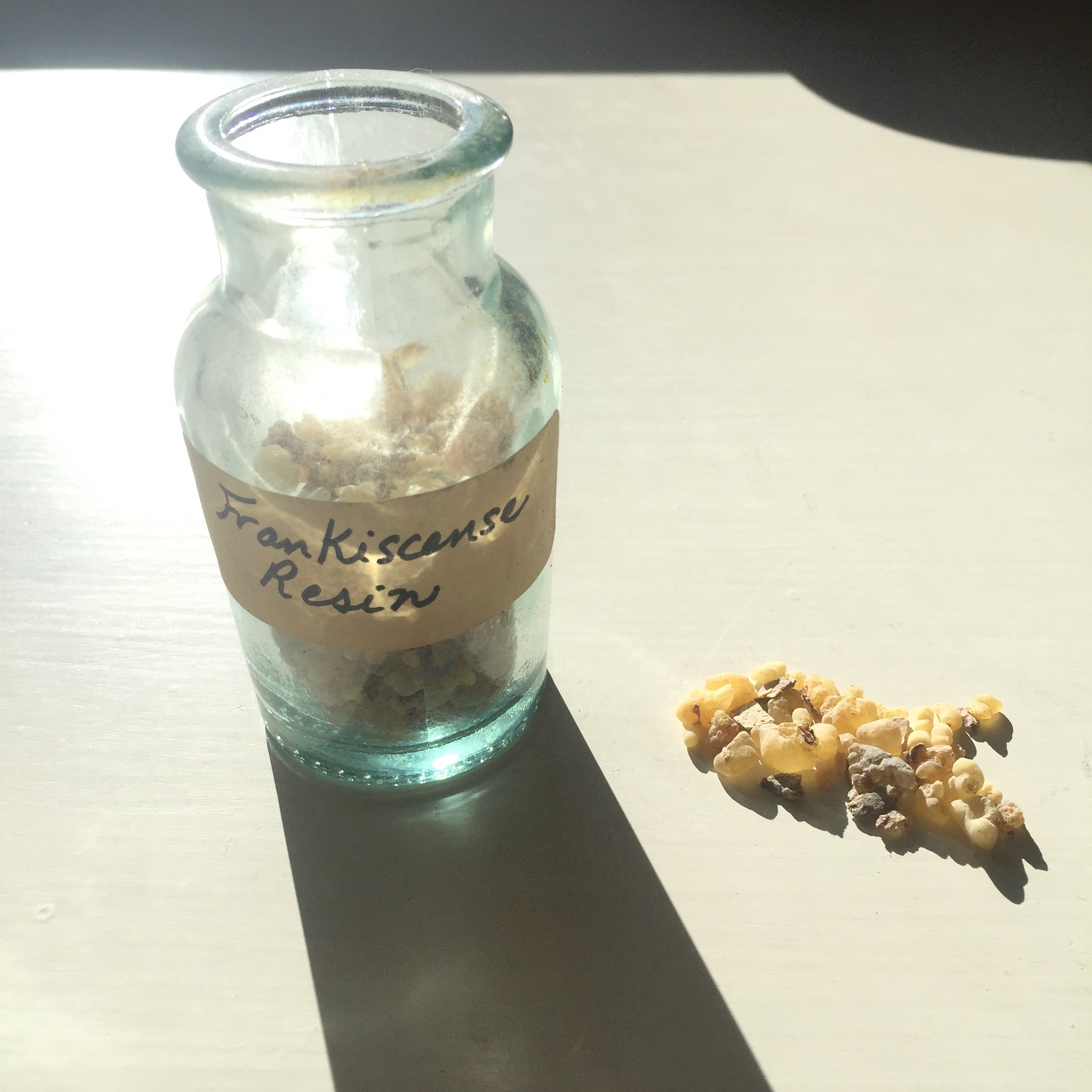
HOW TO USE
Make Frankincense Water:
Place 4-5 small pieces of resin in a quart sized jar. Cover with boiled water, cap, and let steep for a few hours or overnight. The resulting liquid will be light in color and a bit cloudy. Drink up to a cup or so a day, using your taste buds to guide you on your own proper dosage. This tea comes in handy when you are feeling congested. Many people also drink it to help with arthritic or painful joints.
Use the essential oil topically:
Dilute 10 - 15 drops of frankincense essential oil in 1 oz. of a carrier of your choice (olive, jojoba, grapeseed, or almond oil) and rub onto the skin. This is useful for scarring, acne, wrinkles and painful joints.
Burn the resin:
To burn the dried resin use a small charcoal disc (often sold to use in hookahs). Light the charcoal outside on a fire-proof dish and when it finishes smoking and sparking it should simply glow. Place 1 to 3 small pieces of resin on the charcoal and it will start to burn immediately. The resulting incense is pleasant and sweet and can be used to clear and purify the air.
NOTE: Frankincense should not be used during pregnancy, because of its emmenagogue and astringent qualities.
REFERENCES:
Sacred Earth
Dr. Mercola
Enfleurage.com
Steph Zabel, MSc, is an herbalist and educator who helps urban dwellers connect with the plant world. She teaches herbal classes, is available for individual wellness consultations, and is also the founder of HERBSTALK, Boston’s community herbal conference. Learn more about her work at: www.flowerfolkherbs.com and www.herbstalk.org.






This blog series — Herbs and Botanicals— is for general health information only. This Web site is not to be used as a substitute for medical advice, diagnosis or treatment of any health condition or problem. Users of this Web site should not rely on information provided on this Web site for their own health problems. Any questions regarding your own health should be addressed to your own physician or other healthcare provider.
The Tree of Spice: Cinnamon
By Steph Zabel
Herbalist, Ethnobotanist and Educator
For many people, cinnamon evokes thoughts of the holiday season, of tasty desserts and of cozy kitchen aromas. And rightly so, for it is such a common and comforting culinary spice.
Despite being a staple of kitchens throughout the world, cinnamon is very much a plant of the tropics. True cinnamon is a small, evergreen tree that is originally native to Sri Lanka. The aromatic bark is the part that is harvested for use in food and herbal preparations. For ages it has been a highly regarded and often mysterious spice… The Greeks used it to flavor their wine and the ancient Egyptians used it in exotic blends for incense to perfume the air.

By Köhler–s_Medizinal-Pflanzen via Wikipedia
There is often some confusion surrounding the different types of cinnamon, since there are actually several species of trees which are sold on the market. True cinnamon, Cinnamomum verum, (also called Ceylon cinnamon) is grown in Sri Lanka. There is also Cinnamomum cassia, Chinese cinnamon or cassia, which tends to be more commonly sold in powdered form in the United States. To me, cassia cinnamon has a bolder, spicier taste to it, and true cinnamon is lighter and sweeter. Try both kinds to see which one you prefer.
The first time I ever had cinnamon as a tea — yes, it can be drunk as a tea! — I was on a very small island in the Caribbean. The local people there drink cinnamon for upset stomach and digestive issues. I remember feeling so surprised by the tea — how immediately delicious and sweet and warming it was. It was one of the best things I had tasted!
Several herbal traditions around the world also use cinnamon for digestion as it stimulates and supports weak or stagnant digestive organs. It can be especially useful for nausea, vomiting and diarrhea.

By L. Shyamal via Wikipedia
I like to think of cinnamon as a more gentle substitute to ginger. We all know how spicy and warming ginger is, and all the great benefits it has for the digestive system… however, for some people dried ginger is just too hot. If you’re like me and ginger root makes you sweat and feel uncomfortable, you probably already have a warm constitution and don’t need something so strong. Try cinnamon bark instead.
Given the inherent warming properties of cinnamon, it has traditionally been used for “cold” conditions such as a weak digestion, cold extremities or poor circulation. It may also be quite helpful for reducing the uncomfortable symptoms of Reynaud's Syndrome. In women, it can be helpful in improving blood flow to the pelvic region, especially in cases of amenorrhea or fibroids.
Cinnamon also seems to play a role in regulating blood sugar and is often recommended for people with diabetes as it can improve insulin utilization. How interesting, then, that it is such a traditional ingredient in sweet, sugar-filled desserts around the world!
Finally, the bark of this wonderful tree possesses anti-inflammatory properties; as such it may help inhibit allergic reactions by reducing the histamine response caused by seasonal or environmental allergies. Blend a bit of cinnamon bark with nettles to help combat a dripping nose or itchy eyes during allergy season.
HOW TO USE CINNAMON:
➤ To make a tea use up to 1 tablespoon of the dried bark per 2 cups of water. Let simmer for 20 minutes in a small saucepan on low heat. Then strain out the bark. You can use whole cinnamon sticks (crushed) or cinnamon chips.
➤ Use cinnamon bark as a more mild substitute for ginger in teas/chai blends if dried ginger is too warming and stimulating.
➤ Sprinkle powdered cinnamon on top of beverages, warmed milk, or desserts.
Note: It is believed that Cassia cinnamon — which is high in natural coumarins — can be damaging to the liver when used in large quantities over time, especially in sensitive individuals. If you use cassia cinnamon, use only in moderate does. Or, choose to use true cinnamon instead which does not contain the high level of coumarins that cassia does.
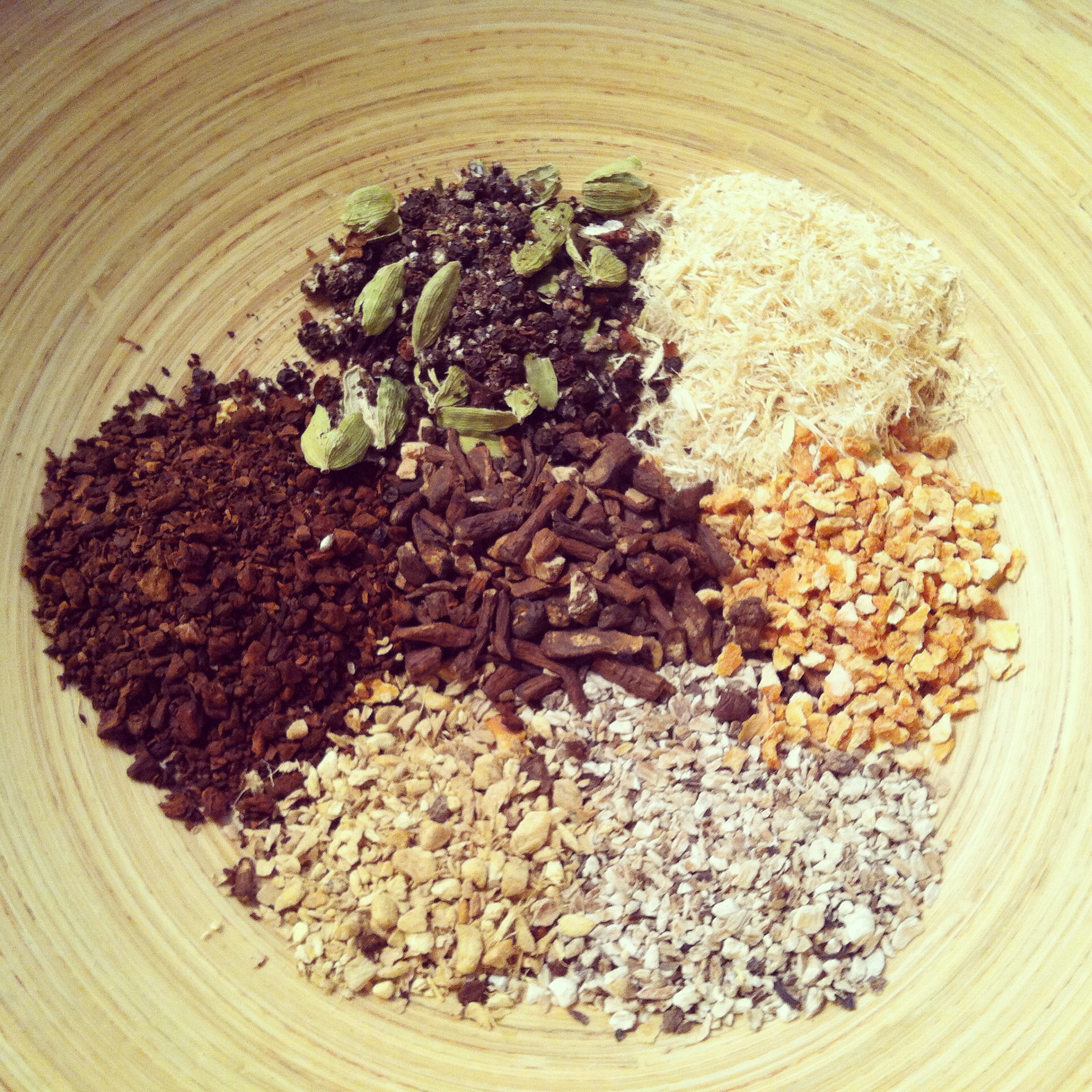
Photo by Steph Zabel
RECIPES:
Here are a few fun cold-weather, holiday recipes below. One is for a cinnamon and apple cordial that will help you stay toasty warm in the winter months, and the other is one of my favorite recipes of all-time, my root chai blend. Enjoy!
Cinnamon Apple Cordial
- 6 cups tart, local apples, seeded and coarsely chopped
- 1 cup raw honey (or more to taste)
- 2 large cinnamon sticks, crushed
- 1/2 vanilla bean pod, sliced in half
- brandy to cover
Combine all ingredients in a large glass jar. Shake often to help the honey dissolve. Let infuse for 4-6 weeks then strain through a cheesecloth and store in a clean, dark colored bottle.
Steph’s Root Chai Blend
- 6 cloves
- 6 cardamom pods
- 1 tsp. black peppercorn
- 1-2 tsp. dried ginger root
- 1 tsp. dried orange peel
- 1/2 Tblsp. cinnamon bark (sweet or cassia)
- 1 Tblsp. burdock root
- 1 Tblsp. roasted dandelion root (roasted will yield a deeper, darker flavor)
- 1 Tblsp. roasted chicory root
- 1 Tblsp. astragalus root
First, grind together the cloves, cardamom and peppercorn in a mortar and pestle. This will help their flavor be dispersed throughout the whole tea. Combine these crushed pieces with the remaining ingredients and mix thoroughly. Store in a tightly capped glass jar. This will make about 5-6 servings of tea.
To brew the tea, add up to 1 Tblsp. of the chai blend per two cups of water in a small saucepan. Bring everything to a boil, then lower the heat and let it simmer covered at for least 20 minutes. Just be sure to keep an eye on the water level and don't let it evaporate too much. When it is as dark and spicy tasting as you would like, strain out the roots and add milk and honey to taste.
REFERENCES
Botanical.com
University of Maryland Gazette
Herb Wisdom
Acupuncture Brooklyn
Steph Zabel, MSc, is an herbalist and educator who helps urban dwellers connect with the plant world. She teaches herbal classes, is available for individual wellness consultations, and is also the founder of HERBSTALK, Boston’s community herbal conference. Learn more about her work at: www.flowerfolkherbs.com and www.herbstalk.org.
*The next Herbstalk event is the Wintergreen Herbal Market taking place on November 26th at the Armory in Somerville! More details can be found here!
This blog series — Herbs and Botanicals— is for general health information only. This Web site is not to be used as a substitute for medical advice, diagnosis or treatment of any health condition or problem. Users of this Web site should not rely on information provided on this Web site for their own health problems. Any questions regarding your own health should be addressed to your own physician or other healthcare provider.
A Wild Fall Fruit: Rosehips (Rosa canina, Rosa rugosa and related species)
By Steph Zabel
Herbalist, Ethnobotanist and Educator
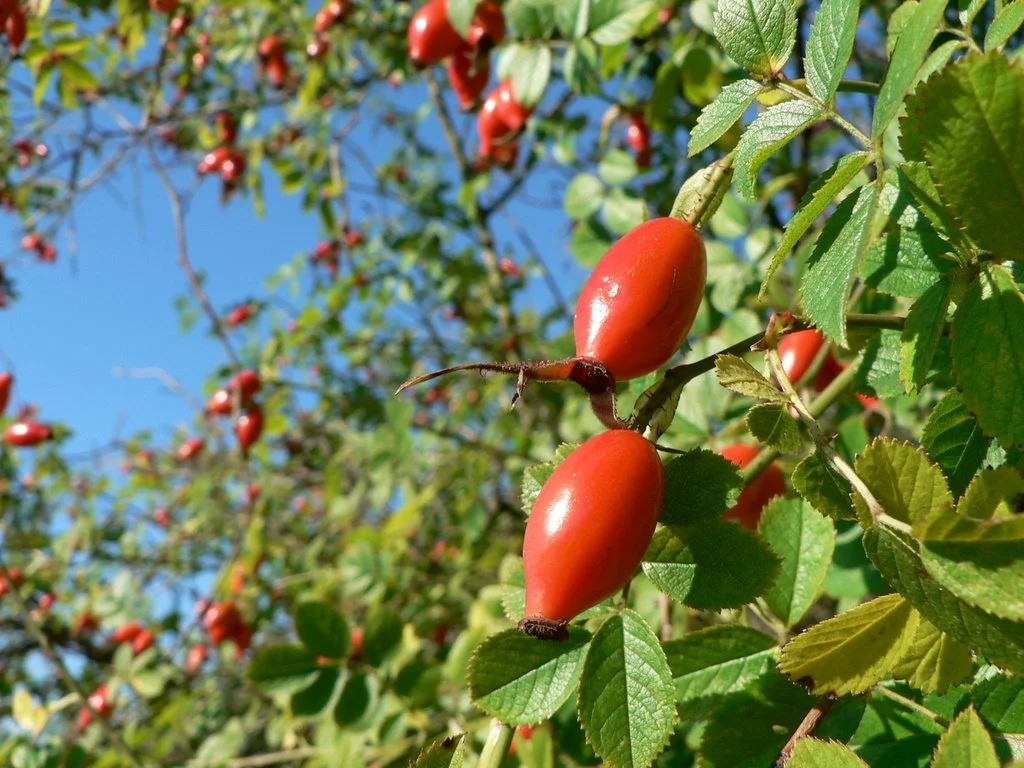
Photo by Rosendahl via Wikimedia Commons
The Rose family (Rosaceae) is one of the most beloved botanical groups; humans have had a deep affinity for these plants for thousands and thousands of years. Not only does this family produce beautiful flowering plants such as spirea, potentilla, lady’s mantle, agrimony and hawthorn, but also important fruit crops such as pears, peaches, plums, cherries, quinces, almonds, raspberries and strawberries. What would our world be like without these delights?!
Of all these family members, Rose is the most well-known and sought-after. She is the true queen of flowers.

Photo by Renee Ricciardi via Wikimedia Commons
While most people are familiar with the aesthetic and olfactory beauty of the rose, in this country there tends to be less familiarity with the fruit of the rose, i.e. the rosehip.
I adore using rosehips this time of year, when the scarlet fruits become full and ripe. All roses will develop hips once their flowers fade, but depending on the species they vary in shape, color, texture and taste. The hip of the dog rose, Rosa canina, is often sold commercially for tea. Around our neck of the woods we are lucky to find Rosa rugosa, the beach rose, which produces the most beautiful, large, tomato-like fruits.
So why would we want to use rosehips?
First of all, these fruits are a delicious wild edible. They are nutritive and tart, and can be infused into a tea that is high in many vitamins, especially Vitamins A and C. Even though citrus fruits get all the glory for being a great source of Vitamin C, rosehips actually contain a higher concentration of this important vitamin and are in fact one of the richest botanical sources of it.
We cannot produce our own Vitamin C so it is essential that we obtain it from food. It is needed for producing hormones, neurotransmitters and hormones in the body. Having plenty of this vitamin in the diet has been correlated with a reduced risk of cancer and cardiovascular disease. In addition, Vitamin C supports the immune system and has been shown to shorten the duration of the common cold. This makes rosehips an excellent addition to fall and winter tea blends.
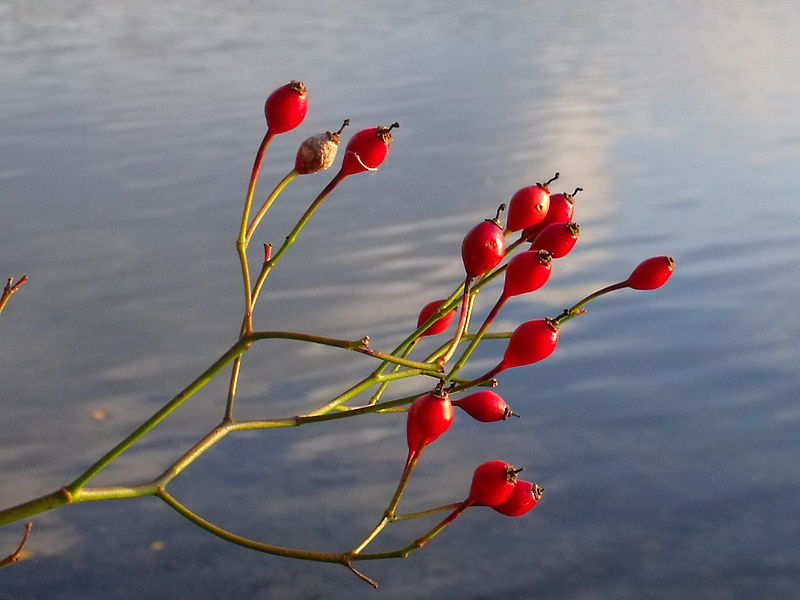
Photo by Oceancetaceen via Wikimedia Commons
Like other red-hued herbs and fruits such as schisandra, hawthorn, and hibiscus, rosehips are high in bioflavonoids which have an antioxidant action that prevents free radical damage in the body. These bioflavonoids also strengthen heart and blood vessels.
Perhaps a lesser known use of rosehips are its effect on the digestive system. The hips are anti-inflammatory and soothing, and so are useful for hot, inflammatory conditions in the gut such as ulcers, colitis or Crohn’s. They are also a gentle laxative that is traditionally used for mild constipation; the natural pectin content has a beneficial, soothing effect on the intestinal tract.
Above all, rosehips are a food. They are commonly harvested to be made into jams and jellys; they can also be baked into pies, used as a thickener for sauces (because of their pectin content), and can even be made into a beautiful soup! (Check out this Swedish rosehip soup recipe I discovered!

Photo by Steph Zabel
HOW TO USE ROSEHIPS
- Infusion: use 1 tsp. of dried rosehips per cup of hot water. Let steep 10-15 minutes.
- You can also decoct rosehips to make a darker, stronger brew but you will lose much of the Vitamin C content with boiling.
- Freshly gathered rosehips can also be made into jam or jelly.
- Blends nicely with other herbs for a subtle, tart flavor. Try blending with holy basil, mint, lavender and/or lemon balm.
MAKING AN OXYMEL
The combination of honey, vinegar and herbs creates an ancient preparation called an oxymel. This simple medicine dates back to the time of the Greeks and has been used for many different ailments, but most especially for digestive and respiratory issues. Today we can make oxymels as a delicious way to preserve our favorite herbs, or to create a medicinal tonic.
The simplest method of making an oxymel is to mix together equal parts honey and apple cider vinegar and pour this mixture over your herbs to steep. (Use more vinegar for a thinner oxymel, less vinegar for a more syrup-y oxymel.)

Photo by Steph Zabel
ROSEHIP OXYMEL RECIPE:
- Fill a pint sized jar 1/3 full of dried rosehips or 1/2 full of fresh, chopped rosehips.
- Cover with a vinegar/honey mixture (start with a 1:1 ratio of vinegar: honey).
- Stir it up to remove air bubbles and cover the top of the jar with a sheet of wax paper before capping if using a metal lid. (Or use a plastic lid to avoid corrosion from the vinegar.)
- Shake those hips! Really… Shake the jar often to make sure the herb does not clump together. Add more vinegar if necessary.
- Let infuse for 2 – 6 weeks. Then strain out using a cheesecloth and store in a tightly capped bottle out of direct sunlight.
Use this tart honey-vinegar concoction directly by the spoonful, or add to seltzer water for a refreshing drink. You can also use it as the base for sauces, marinades and salad dressings.
REFERENCES
Botanical Online
Oregon State
Sacred Earth
Vegetarian Nutrition
Steph Zabel, MSc, is an herbalist and educator who helps urban dwellers connect with the plant world. She teaches herbal classes, is available for individual wellness consultations, and is also the founder of HERBSTALK, Boston’s community herbal conference. Learn more about her work at: www.flowerfolkherbs.com and www.herbstalk.org.
*The next Herbstalk event is the Wintergreen Herbal Market taking place on November 26th at the Armory in Somerville! More details can be found here.
This blog series — Herbs and Botanicals— is for general health information only. This Web site is not to be used as a substitute for medical advice, diagnosis or treatment of any health condition or problem. Users of this Web site should not rely on information provided on this Web site for their own health problems. Any questions regarding your own health should be addressed to your own physician or other healthcare provider.
COMFREY (Symphytum officinale): A healer of wounds, bruises and bones
By Steph Zabel
Herbalist, Ethnobotanist and Educator
September’s herb is a bit different than all of our past monthly plant profiles. This month we focus on the great green healer, comfrey. But, unlike all the other plants we’ve covered here, comfrey is meant for external use only, rather than for taking internally. (And I’ll explain why as we go along.)
Perhaps you’ve seen this lush, leafy plant growing in a garden, or even alongside the edge of a forest, where it has escaped cultivation and is happily growing in the partial shade. If you walk along the Somerville bike path you are sure to see some half-wild comfrey growing along the edges. In the summertime you’ll notice it’s lovely violet-hued flowers which are born on a spiral-shaped stalk and hang downwards like small bells.
By Steph Zabel
Herbalist, Ethnobotanist and Educator
September’s herb is a bit different than all of our past monthly plant profiles. This month we focus on the great green healer, comfrey. But, unlike all the other plants we’ve covered here, comfrey is meant for external use only, rather than for taking internally. (And I’ll explain why as we go along.)
Perhaps you’ve seen this lush, leafy plant growing in a garden, or even alongside the edge of a forest, where it has escaped cultivation and is happily growing in the partial shade. If you walk along the Somerville bike path you are sure to see some half-wild comfrey growing along the edges. In the summertime you’ll notice it’s lovely violet-hued flowers which are born on a spiral-shaped stalk and hang downwards like small bells.
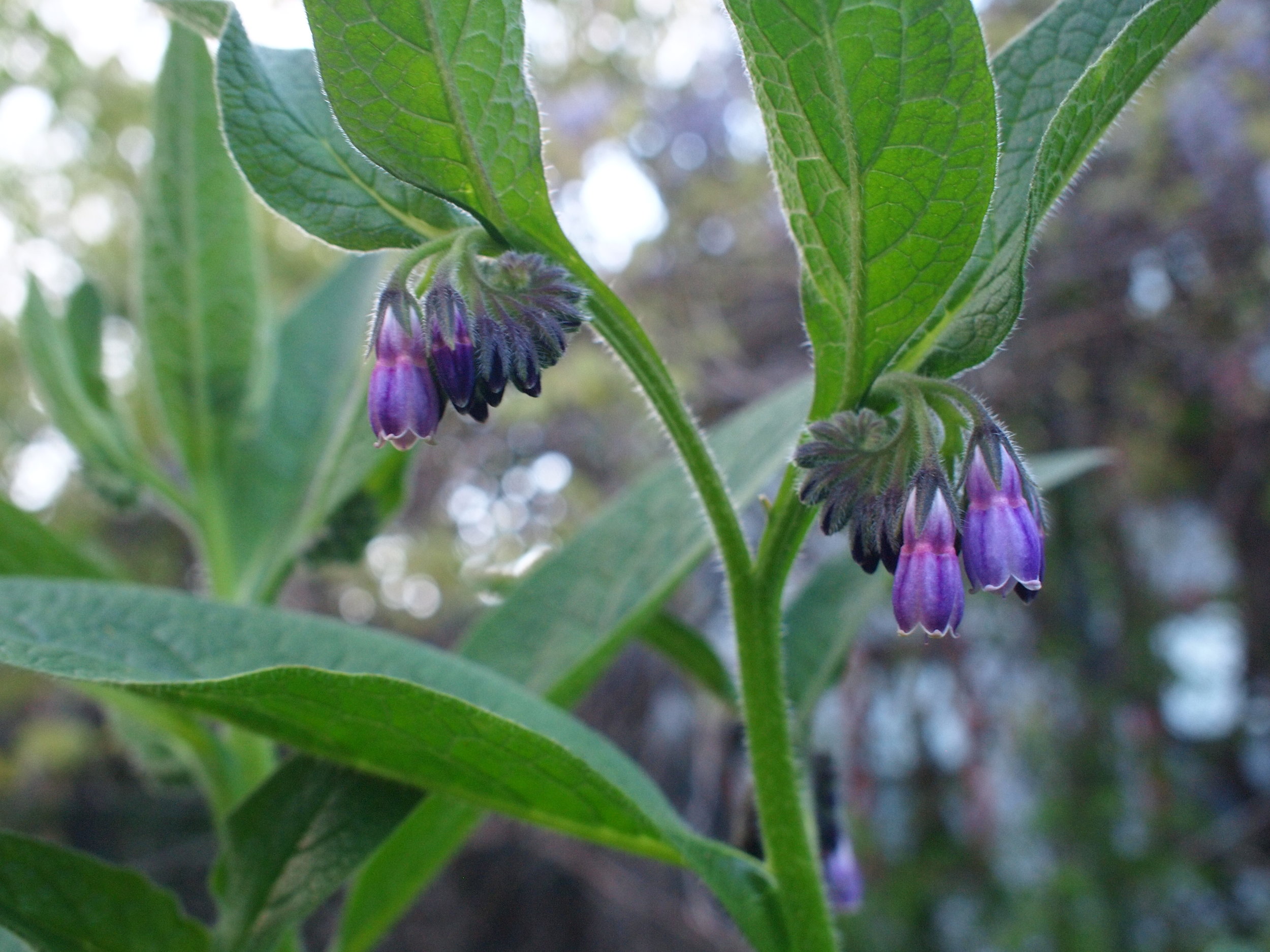

This lovely plant is originally native to Europe but it’s commonly found naturalized throughout parts of North America. Early colonists brought the plant with them when they settled in the new land.
Comfrey was once commonly called Knitbone because of its amazing ability to heal broken bones and “knit” them back together again. The botanical name, Symphytum, means “to unite.”
The incredible healing action this plant has on broken bones and wounds comes from a constituent contained in the leaf and root called allantoin. This compound is a cell proliferant which helps to regenerate wounded areas of the body and speed up new healthy cell growth.
Comfrey is one of my favorite herbs for bruises, especially, and I have seen it work its magic overnight. I once witnessed the external application of comfrey placed on terrible blue-black colored bruises and after being on the effected area for one night (as a poultice) the bruises quickly started to fade and went from black in color to a pale yellow. It was amazing to see this transformation happen so rapidly.
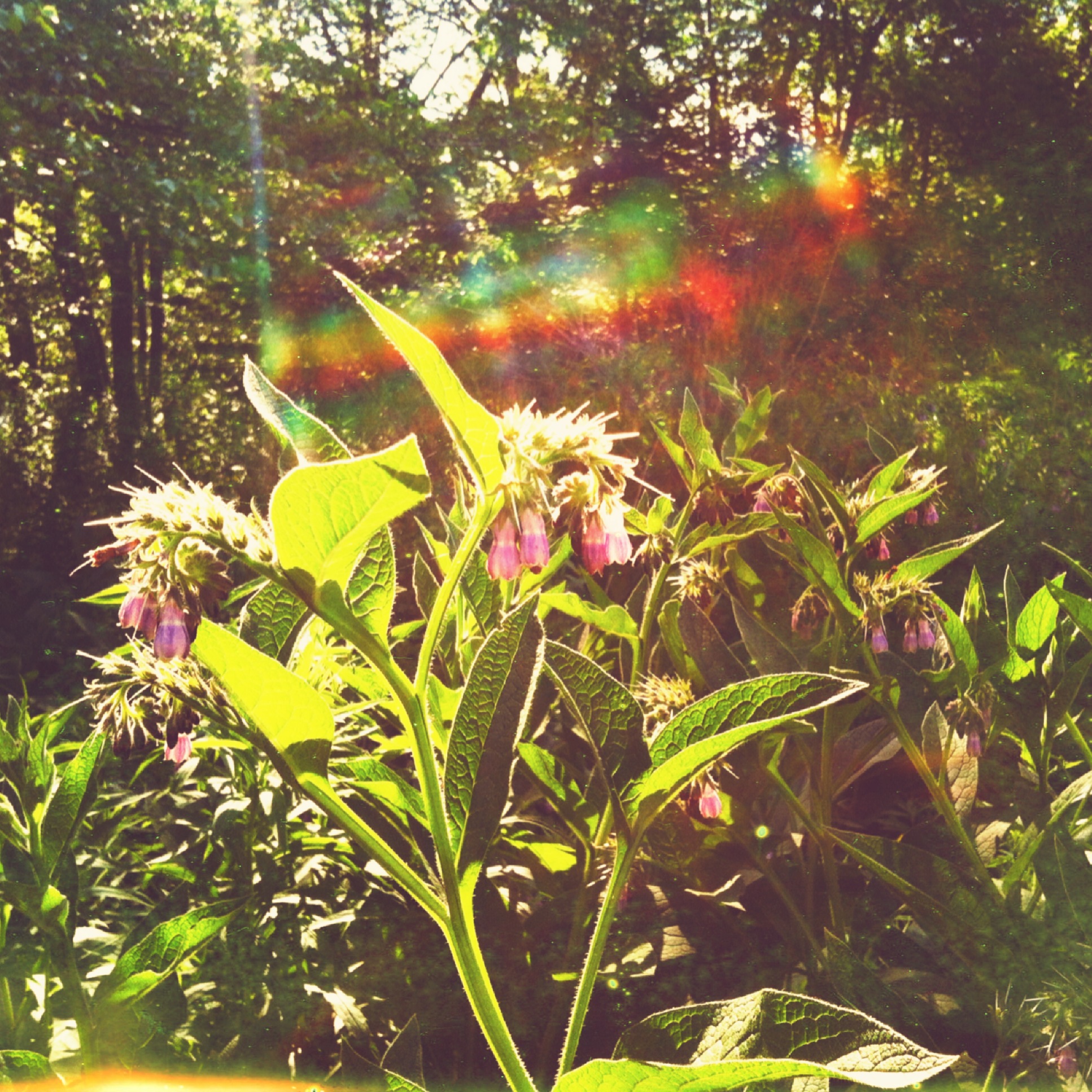
The plant is also excellent to use topically on sprains, pulled muscles, swellings and fractures. It is a wonderful first aid herb to have on hand in case you or someone you know twists their ankle. A foot soak or a poultice of comfrey can bring relief and help speed up the healing process.
But comfrey must be used with caution and respect. It is such an excellent and speedy wound-healing remedy that it actually should not be used on deep wounds or lacerations. It could potentially heal the top layer of skin before the bottom layer, resulting in an abscess. So please do avoid comfrey for major skin wounds, and use it only for bruises, sprains and minor cuts and scratches.
In addition, much debate surrounds the safety of consuming comfrey internally, even though for centuries it was used in Greek medicine and by European physicians for respiratory and digestive issues. The controversy is due to the fact that the plant contains pyrrolizidine alkaloids that can be harmful to the liver in high doses. These alkaloids can do damage — especially to people who already have a compromised liver — so it is advised to use comfrey topically and not internally to be on the safe side.
That said, there is no reason to fear this plant when it is used correctly. Just don’t use comfrey on deep open wounds, and avoid all internal use.
HOW TO USE:
There are many ways to use comfrey topically on the body through compresses, poultices, liniments and infused oils. One of my favorite ways is to make a simple compress. If you’ve never made one before, it may sound daunting but it is actually very straightforward. A compress is simply a cloth soaked in an herbal tea (or sometimes a tincture or oil) and then placed on the the body. The skin absorbs the healing properties of the liquid and penetrates to the affected area. Compresses can be applied warm or cold. Warm compresses will be more relaxing, help with muscle tightness and bring more blood to the area. Cold compresses are constricting, slow down circulation and can help reduce bleeding and pain.

HOW TO MAKE A COMPRESS:
Make a strong comfrey tea, using 2 Tablespoons of dried herb per cup of hot water. Strain out the herb after 10-15 minutes.
Let the tea cool if making a cold compress, or use it right away (at a comfortable temperature) for a warm compress. The tea can be heated back up if necessary.
Soak a clean piece of fabric or a washcloth in the tea and squeeze out the excess liquid.
Place the soaked cloth on the affected area and, if possible, wrap it around the body. Let it sit for at least 10 minutes. Re-soak the cloth as needed.
Steph Zabel, MSc, is an herbalist and educator who helps urban dwellers connect with the plant world. She teaches herbal classes, is available for individual wellness consultations, and is also the founder of HERBSTALK, Boston’s community herbal conference. Learn more about her work at: www.flowerfolkherbs.com and www.herbstalk.org.
References:
http://www.botanical.com/botanical/mgmh/c/comfre92.html
http://umm.edu/health/medical/altmed/herb/comfrey
This blog post — COMFREY (Symphytum officinale): A healer of wounds, bruises and bones — is for general health information only. This blog post is not to be used as a substitute for medical advice, diagnosis or treatment of any health condition or problem. Users of this Web site should not rely on information provided on this Web site for their own health problems. Any questions regarding your own health should be addressed to your own physician or other healthcare provider.
Herb of the Month: Chamomile
CHAMOMILE: Matricaria recutita and Chamaemelum nobile (Anthemis nobilis) Asteraceae
By Steph Zabel
Herbalist, Ethnobotanist and Educator
The Greeks call it earth apple, Germans call it mother’s herb, and in Mexico it is known as manzanilla, or little apple. No matter the name, no matter the language, chamomile is a culturally important plant known and loved around the world.
CHAMOMILE: Matricaria recutita and Chamaemelum nobile (Anthemis nobilis) Asteraceae
By Steph Zabel
Herbalist, Ethnobotanist and Educator
The Greeks call it earth apple, Germans call it mother’s herb, and in Mexico it is known as manzanilla, or little apple. No matter the name, no matter the language, chamomile is a culturally important plant known and loved around the world.
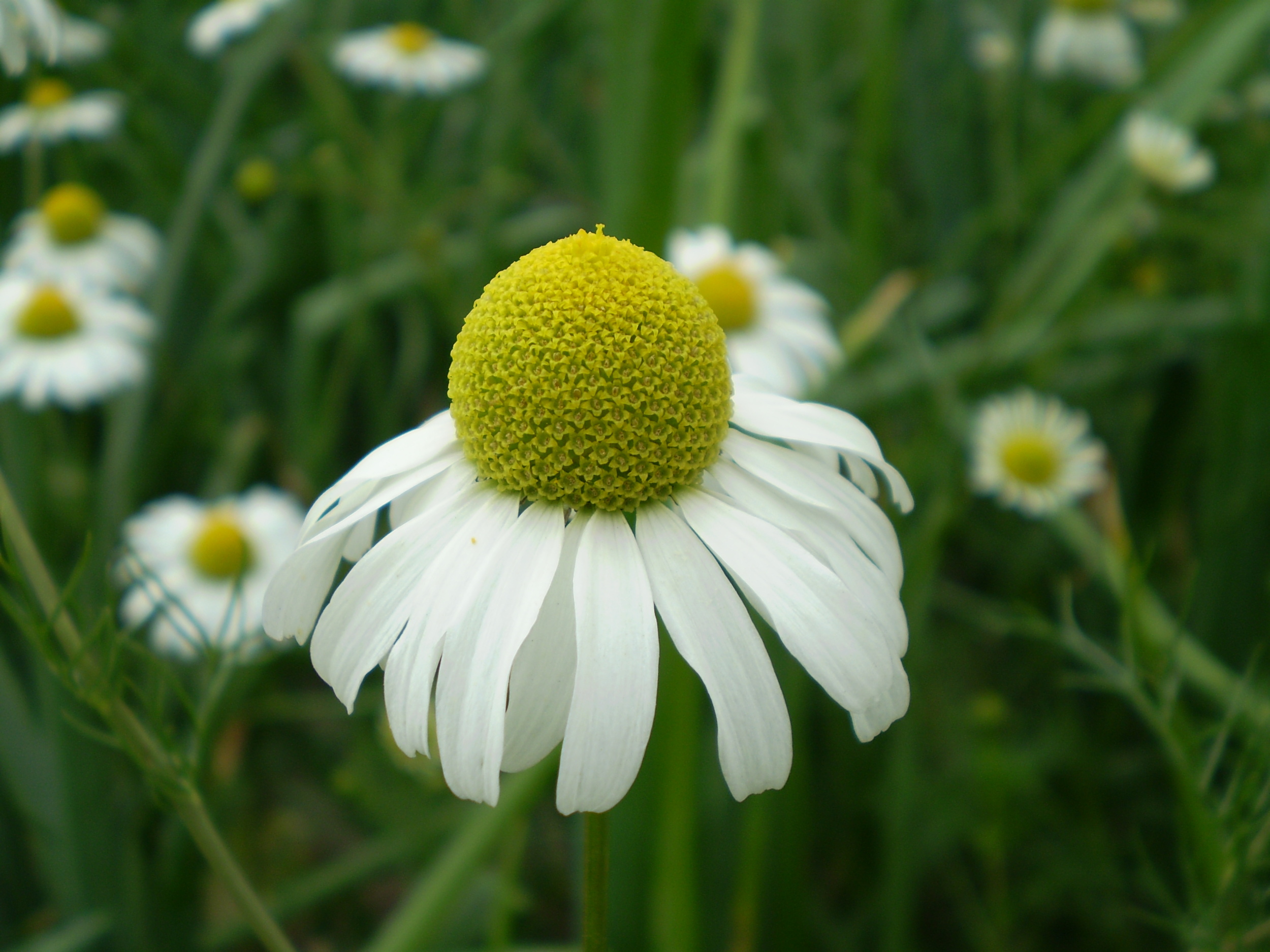
Photo Credit Rob Hille via Wikipedia

Photo Credit Mussklprozz via Wikipedia
Due to its lovely aromatic scent combined with its very useful actions on the human body, chamomile has become one of our most common and recognizable herbs. Practically all restaurants and cafes serve up chamomile tea, and it is one of the few medicinal herbs that all grocery stores will stock in their tea sections. Could there be anyone who has not had chamomile tea before? It is a flavor that is known by almost everyone.
There are two plants that are called chamomile: the more popular and common German chamomile (Matricaria recutita) and the Roman chamomile (Chamaemelum nobile). Although they are different species, they are used interchangeably in herbal medicine. Both are very aromatic, with the lovely, sweet scent of apples.

Photo credit: Köhler's Medizinal-Pflanzen, published 1887 via Wikipedia
Chamomile has been used as a medicine for thousands of years, dating back to the ancient Egyptians, Romans, and Greeks. It was also one of the nine sacred herbs of the Anglo-Saxons. Because of its various healing powers, chamomile was believed to be a gift of the gods.
When we think of chamomile first we must think of its affinity for the digestive organs. This cheery herb is renowned for its use in various ailments such as indigestion, stomach-ache, flatulence, and inflammation in the gut. Chamomile contains an essential oil called azulene, which is a beautiful deep blue oil when distilled. This oil possesses tremendous anti-inflammatory properties that helps soothe and relax the walls of the intestines and remove excess gas. In addition, although chamomile has a sweet aroma and taste to it, it is also mildly bitter. This bitterness helps stimulate liver function and the production of bile, thus aiding in the overall process of digestion. Chamomile truly shines for issues of the stomach and intestines, and is a wonderful and easy addition to the home apothecary.
Chamomile is also an excellent herb for nervousness, tension and anxiety, especially for the type that manifests in the digestive organs (i.e. that feeling of knots or butterflies in the stomach). The flowers have traditionally been used to calm frayed nerves, and to quell irritable behavior. For most people a cup of chamomile tea is instantly relaxing and soothing. It is perfect as a before bedtime tea, or after a long and stressful day.
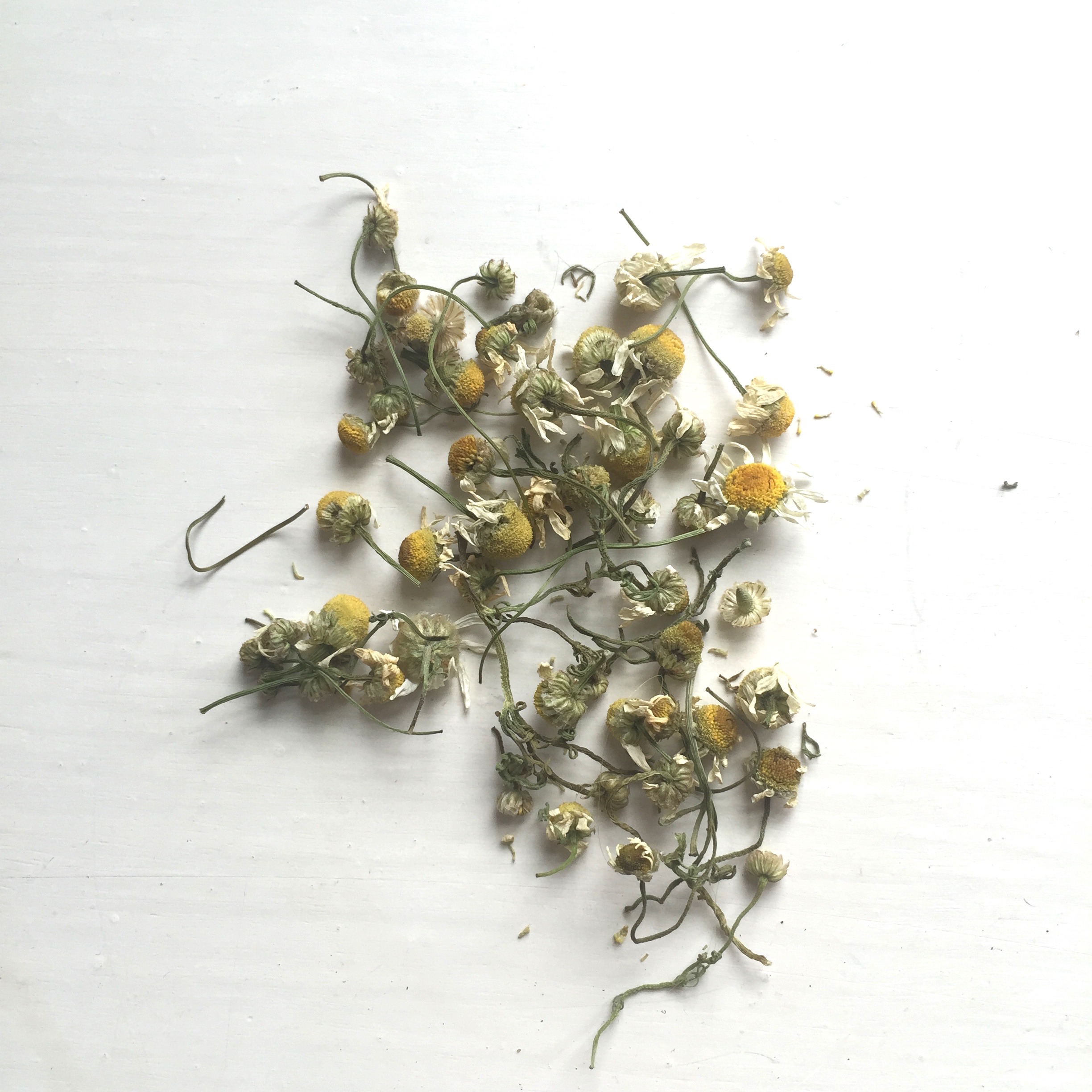
Photo credit: Steph Zabel
Perhaps chamomile is most famous for its use with babies and children; it is after all called the “mother’s herb” in Germany for good reason. It is very safe for young people and especially suited to children who are irritable, whining, hypersensitive and/or restless. Given as a diluted tea, or used in a bath, chamomile calms irritable behavior. And this action isn’t just for children! One of our most famous American herbalists, Matthew Wood, is often quoted on chamomile, writing that it is “the remedy for babies of any age.” In my own practice, I find this to be very true! Chamomile is wonderful for any temperamental outbursts, heated emotions, or irritable and childish behavior. Every now and then, we all must whine and complain, but when it becomes a constant theme, chamomile is the answer!
On another note, here on the east coast we have a close cousin of chamomile that grows wild in lawns and pathways where humans walk. Called pineapple weed (Matricaria matricarioides), this plant grows abundantly throughout the city and has an intoxicating sweet scent. Its flowers are not as showy as true chamomile since they lack the white ray petals, but if you take the yellow center and crush it between your fingers you will be amazed at its amazingly strong scent. Pineapple weed can be used just like chamomile.
A word of caution: A small number of people are allergic to chamomile and other related plants in the Asteraceae family, so do be aware that it may provoke an allergic reaction in people who are sensitive.
HOW TO USE CHAMOMILE:
Tea infusion: Use 2 teaspoons of the dried herb per cup of hot water. Cover and let steep up to 10 minutes. It becomes quite bitter the longer it is steeped.
Chamomile mixes well with peppermint, sage, fennel, calendula and/or wood betony for digestive issues
Tincture: Use 10 to 30 drops of chamomile tincture as needed for stomach ache, tension or nervousness
Essential oil: Use 10 to 15 drops of the essential oil diluted in a carrier oil (such as olive oil) for topical use on minor wounds and inflammation
RECIPE: Chamomile infused wine
1 bottle of your favorite white wine (a sweet wine like a Riesling would work well)
2 - 3 tablespoons of dried chamomile flowers
Place the chamomile in a quart sized glass jar. Pour the wine over the herb. (A whole bottle of wine will fit into a quart sized jar.) Give it a stir so that the chamomile is completely submerged in the wine. Cap with a lid and keep at room temperature for at least 3 hours. Or, steep for longer (up to 8 hours) for a stronger flavor. Pour the wine through a fine sieve to remove the chamomile. Enjoy chilled for a sweet and relaxing summer wine.
Steph Zabel, MSc, is an herbalist and educator who helps urban dwellers connect with the plant world. She teaches herbal classes, is available for individual wellness consultations, and is also the founder of HERBSTALK, Boston’s community herbal conference. Learn more about her work at: www.flowerfolkherbs.com and www.herbstalk.org.
References:
https://whisperingearth.co.uk/2010/04/17/more-musings-on-chamomile-a-herb-for-the-child-in-us-all/
http://umm.edu/health/medical/altmed/herb/german-chamomile
http://www.botanical.com/botanical/mgmh/c/chammo49.html
http://www.ncbi.nlm.nih.gov/pmc/articles/PMC3210003/
The Book of Herbal Wisdom by Matthew Wood
Herbs: Partners in Life by Adele G. Dawson
This blog post — Herb of the Month: Chamomile — is for general health information only. This blog post is not to be used as a substitute for medical advice, diagnosis or treatment of any health condition or problem. Users of this Web site should not rely on information provided on this Web site for their own health problems. Any questions regarding your own health should be addressed to your own physician or other healthcare provider.
Mugwort: A Wild Beauty in Urban Places
By Steph Zabel
Herbalist, Ethnobotanist and Educator
When I first moved to Boston a decade ago I felt like a country girl in the big city. I’d traveled and lived in several places before, but had never before set down roots in an urban environment. I was used to living amongst trees and woods, and wide-open spaces. Although I loved my new city home, I greatly missed natural open spaces, and forests, and wild places.
So I found consolation in a different sort of wildness: in untamed, weedy plants that sprout up in the neglected areas of town. Of all of these – the dandelions, chickweeds, shepherd’s purses and burdocks that I came to know and love – mugwort was the one to capture me the most.
When I first made acquaintances with this lovely creature I knew nothing of the plant, not even its name. I just loved the beautiful shape, tall stature, silvery leaves, and gracefulness as I observed mugwort swaying in the wind, or in the passing rumble of a train.
By Steph Zabel
Herbalist, Ethnobotanist and Educator
When I first moved to Boston a decade ago I felt like a country girl in the big city. I’d traveled and lived in several places before, but had never before set down roots in an urban environment. I was used to living amongst trees and woods, and wide-open spaces. Although I loved my new city home, I greatly missed natural open spaces, and forests, and wild places.
So I found consolation in a different sort of wildness: in untamed, weedy plants that sprout up in the neglected areas of town. Of all of these – the dandelions, chickweeds, shepherd’s purses and burdocks that I came to know and love – mugwort was the one to capture me the most.
When I first made acquaintances with this lovely creature I knew nothing of the plant, not even its name. I just loved the beautiful shape, tall stature, silvery leaves, and gracefulness as I observed mugwort swaying in the wind, or in the passing rumble of a train.


I used to walk one particular route to work that always led me past a population of mugwort. It was an unpleasant and ugly stretch to walk through, full of trash and city grime, but the mugwort always provided a glimpse of beauty and grace with its silvery green glow. It felt like the mugwort was welcoming me to my new city, and whispered to me an important reminder: that I could find beauty wherever I looked for it.
Upon delving deeper into my work with the herbs I discovered many things about mugwort that enamored me with the plant even more. I found out that it is a plant of ancient use and was known as the Mater Herbarum — the mother of all herbs. Mugwort was held sacred by various cultures and thought to be the oldest of plants. In particular it was believed to be a plant that offered protection to humans. It was once common to hang a sprig of mugwort over the doorway — or to burn it as an incense — to keep illness and evil spirits away from the home.
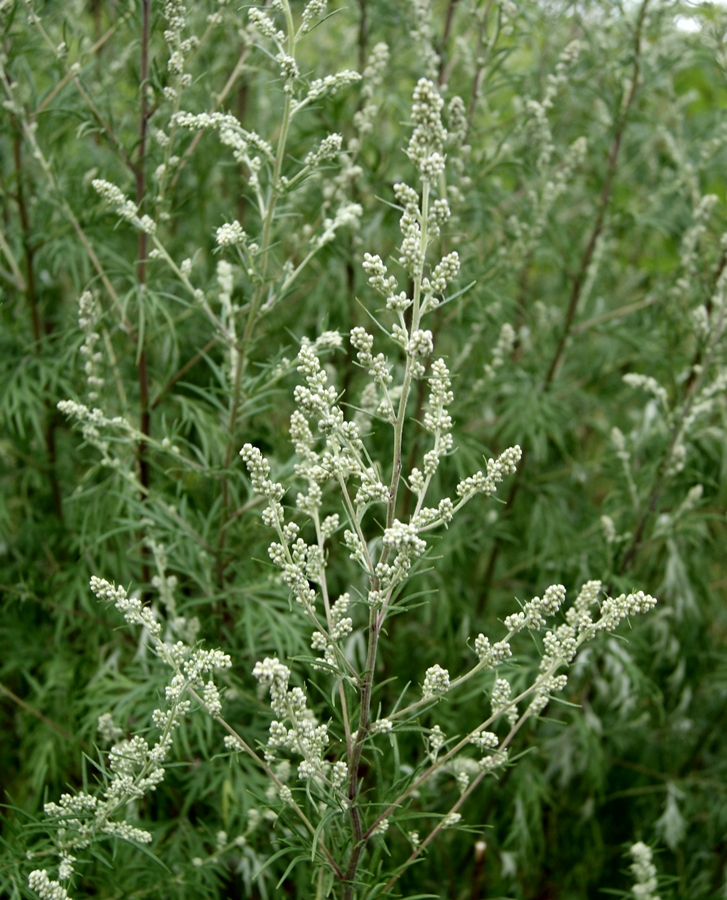
Its botanical name Artemisia refers to the goddess Artemis, hinting at its divine origins. Named after the lunar goddess of childbearing and the wilderness, mugwort is steeped in much folklore about its healing virtues. It has traditionally held a powerful affiliation with the moon and was considered to be a prime herb for women. Artemisia vulgaris has been used to soothe the pain of childbirth as well as monthly menstrual cramping. It may also help to regulate the menstrual cycle to a normal, cyclical rhythm. Herbalist Matthew Wood says that mugwort will restore the injured female nature.
Mugwort’s actions on the body are warming and slightly stimulating. As such it helps to increase circulation throughout the body and to remove stagnant blood (hence its use for the menstrual cycle). In Traditional Chinese medicine a related Artemisia species is made into moxa for use over stiff joints and cold, stagnant areas of the body.
As for its stimulating properties, mugwort is well known for its ability to impart vivid dreams and to promote creative meditation. Many people will find that simply drinking a cup of mugwort tea before bed will have a marked effect on their dreams. Because of this property, however, avoid mugwort when you are trying to get a deep and restorative night’s sleep!
I love what one of my favorite herbal writers, Judith Berger, has to say about this special plant. She says that regular use of mugwort “strengthens our ability to absorb intuitive information as we preserve an aspect of sharpness in our interaction with the complex, topside world.” In other words, mugwort helps us to enhance our intuition in order to better navigate daily reality.
Mugwort can be found growing in disturbed areas and along roadsides wherever humans reside. If you are harvesting the plant for internal use be sure to avoid collecting near traffic-laden roads, or in areas where the soil may be contaminated. Clip the tall stalks so that you are harvesting the upper third of the plant. The best time to collect mugwort is right before its very tiny flower buds open. Hang a bundle of the stalks upside down to dry.
HOW TO USE MUGWORT:
➤ Use 1/2 to 1 tablespoon of dried herb per mug of hot water; let steep at least 10 minutes. Drink before bedtime to increase dreams.
➤ Infuse into vinegar to extract its rich mineral content (mugwort is high in calcium and magnesium)
➤ Infuse into oil to use for topical applications as a warming, stimulating remedy, for cold joints or for menstrual cramping
Caution: As a uterine stimulant and emmenogogue, mugwort should not be used during pregnancy.
MUGWORT DREAM TEA
Here’s a lovely tea that I like to make after dinner to help wind down before bed-time, and to ease me into the dream world:
1 part linden
1 part lemon balm
½ part oat tops
¼ part mugwort
small pinch of lavender
Let steep for at least 15 minutes. Sip mindfully and breathe in the vapor of the tea, and see if you don’t have a very deep night’s sleep, with dreams that you remember the next day…
Steph Zabel, MSc, is an herbalist and educator who helps urban dwellers connect with the plant world. She teaches herbal classes, is available for individual wellness consultations, and is also the founder of HERBSTALK, Boston’s community herbal conference (taking place on June 4 & 5!). Learn more about her work at: www.flowerfolkherbs.com and www.herbstalk.org.
Resources:
Herbal Rituals by Judith Berger
The Earthwise Herbal: A Complete Guide to New World Medicinal Plants by Matthew Wood
http://www.bloodandspicebush.com/blog/mugwort-the-cingulum-sancti-johannis
https://www.botanical.com/botanical/mgmh/m/mugwor61.html
http://www.eattheweeds.com/mugwort/
http://www.herbalpedia.com/Mugwort.pdf
This blog post — Chickweed: Stellaria media — is for general health information only. This blog post is not to be used as a substitute for medical advice, diagnosis or treatment of any health condition or problem. Users of this Web site should not rely on information provided on this Web site for their own health problems. Any questions regarding your own health should be addressed to your own physician or other healthcare provider.
Chickweed: Stellaria media
By Steph Zabel
Herbalist, Ethnobotanist and Educator
You probably already know this if you have attended one of my herbal classes, but I love weeds! Yes, I have a great fondness for the plants that everyone tries to get rid of and “keep under control” especially the tenacious ones that keep on growing where nothing else could…. the crack of a sidewalk, compacted and poor soil, the top of a bridge, along railroad tracks, etc.
I love weeds because they are spunky and resourceful, and in some cases they are beneficial to the local ecosystem. These plants will hold down eroding soil, remove heavy metals, and/or provide greater soil fertility and organic matter. They grow in niches where more delicate plants cannot.
By Steph Zabel
Herbalist, Ethnobotanist and Educator
You probably already know this if you have attended one of my herbal classes, but I love weeds! Yes, I have a great fondness for the plants that everyone tries to get rid of and “keep under control” especially the tenacious ones that keep on growing where nothing else could…. the crack of a sidewalk, compacted and poor soil, the top of a bridge, along railroad tracks, etc.
I love weeds because they are spunky and resourceful, and in some cases they are beneficial to the local ecosystem. These plants will hold down eroding soil, remove heavy metals, and/or provide greater soil fertility and organic matter. They grow in niches where more delicate plants cannot.
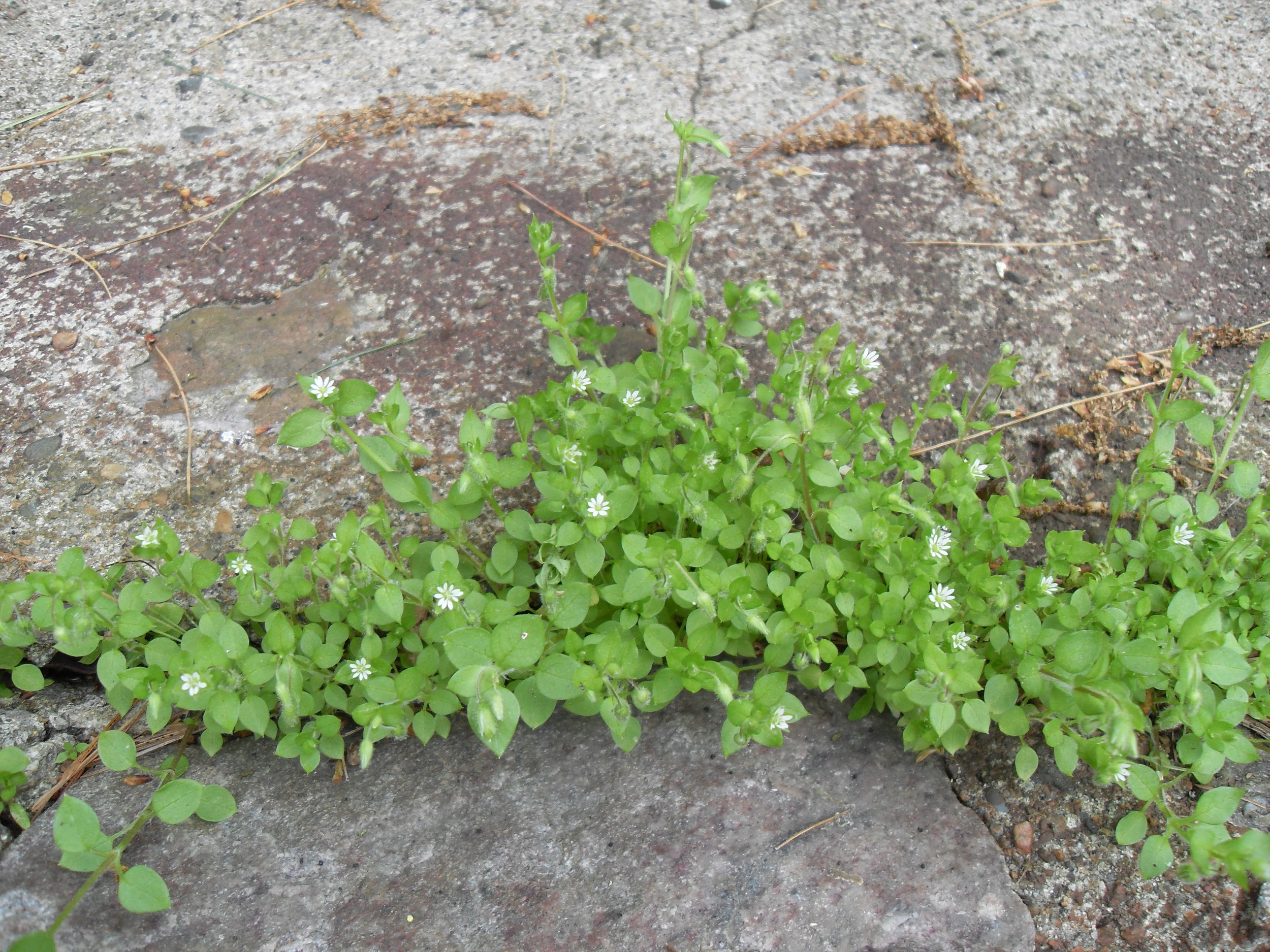
Additionally, many of these so-called weeds make for good foods and remedies for humans. So, before you decide to remove a weedy creature from your garden or lawn, please consider all of the above qualities and appreciate the vitality that is found in wild plants!
Now, onto Chickweed, one of our delightfully weedy plants that can be seen around town.
First and foremost, chickweed is an abundant wild edible. It makes for a refreshing salad green and is a traditional spring tonic. It is very nutritious, being high in chlorophyll, vitamins A & C, and minerals such as calcium, magnesium, phosphorus, and potassium. Chickweed is a wonderful herb to help support the liver and the whole lymphatic system. Traditionally it is used to remove metabolic wastes and excess fats from the body.
If you make a tea of chickweed you might notice an interesting property that it has: when you pour hot water over the dried leaves you’ll see a foamy substance that rises to the top. This is because chickweed contains saponins, which are soap-like substances that increase the permeability of cells. This quality helps our human bodies to absorb more nutrients while also helping us to break down waste products, including excess mucous, toxins and fat cells. This makes it a perfect spring herb to turn to when our bodies need to wake up — and lighten up — after a long winter.

Photograph by Curtis Clark via Wikicommons
On the herbal spectrum of actions chickweed is considered to be a cooling and demulcent herb. It is soothing and moisturizing for the body’s tissues, both internally and externally. Chickweed can be used for any sort of hot, inflammatory condition such as colitis, sore throat, itchy or inflamed skin, or even stings, burns and sunburn. I think it is especially wonderful for irritated and red eyes. A simple poultice of fresh chickweed placed over the eyes will bring cooling relief.
Now in early spring is the time to scope out wild chickweed; before too long it will start to fade in the hot summer sun. Watch out for its dainty white, star-shaped flowers, and brilliant green leaves. It may be an over-looked plant but once you learn how to identify chickweed you will be surprised to see it growing abundantly, spreading like tiny stars across the city.
HOW TO USE CHICKWEED:
- It is best to use chickweed when it is fresh — the young, spring-gathered plant can be eaten raw in salads, or made into an herbal pesto.
- If it is not possible to get your hands on fresh chickweed, an infusion of the dried leaf can be made with 1 Tblsp. of the herb per 1 cup of water. Let this brew steep for 4 to 8 hours in order to extract the most minerals out of it.
- If purchasing a tincture of chickweed, make sure it was made with the fresh plant, rather than the dried herb.
Steph Zabel, MSc, is an herbalist and educator who helps urban dwellers connect with the plant world. She teaches herbal classes, is available for individual wellness consultations, and is also the founder of HERBSTALK, Boston’s community herbal conference. Learn more about her work at: www.flowerfolkherbs.com and www.herbstalk.org.
References:
http://annemcintyre.com/stellaria-media-•-chickweed/
https://www.botanical.com/botanical/mgmh/c/chickw60.html
http://www.susunweed.com/herbal_ezine/May08/healingwise.htm
http://www.thepracticalherbalist.com/holistic-medicine-library/chickweed-skin-rejuvenator/
This blog post — Chickweed: Stellaria media — is for general health information only. This blog post is not to be used as a substitute for medical advice, diagnosis or treatment of any health condition or problem. Users of this Web site should not rely on information provided on this Web site for their own health problems. Any questions regarding your own health should be addressed to your own physician or other healthcare provider.
Passionflower: Passiflora incarnata
By Steph Zabel
Herbalist, Ethnobotanist and Educator
There may not be an herb as striking and gorgeous as passionflower. Its circular, whirling, complex blossom is breathtaking. And although it seems to be an exotic species that comes from a far off place, it is a plant that is native to the southeastern part of our country.
Growing up in South Carolina I have vivid memories of passionflower vines from my childhood. My grandparents grew them outside of their home, and we also found them growing wild along the edges of the streets where we walked. My cousins and I would stop and exclaim if we found a passionflower in bloom. It always seemed like a little piece of magic that we stumbled upon at those times — something intensely beautiful and mysterious that stood out like a spark in the landscape.
By Steph Zabel
Herbalist, Ethnobotanist and Educator
There may not be an herb as striking and gorgeous as passionflower. Its circular, whirling, complex blossom is breathtaking. And although it seems to be an exotic species that comes from a far off place, it is a plant that is native to the southeastern part of our country.
Growing up in South Carolina I have vivid memories of passionflower vines from my childhood. My grandparents grew them outside of their home, and we also found them growing wild along the edges of the streets where we walked. My cousins and I would stop and exclaim if we found a passionflower in bloom. It always seemed like a little piece of magic that we stumbled upon at those times — something intensely beautiful and mysterious that stood out like a spark in the landscape.
Going back south for visits I frequently spy tangly nests of passionflower vines growing in ditches along the roadside. Sometimes they find something else to climb upon; other times they spread out in unruly waves along the ground.
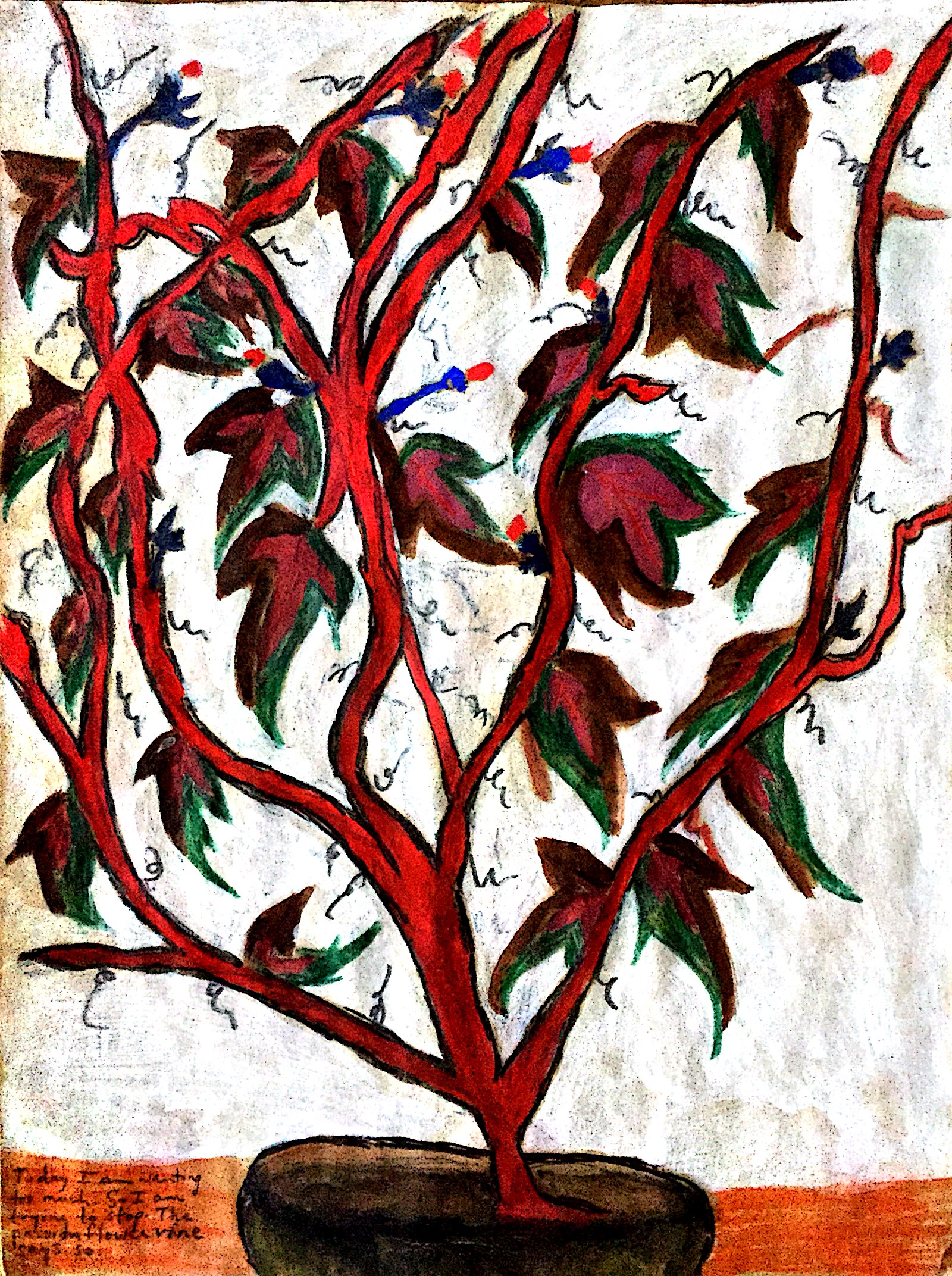
Passionflower Drawing by Steph Zabel
Vining plants are unique in their growing habits, unlike trees and shrubs and flowers that are naturally upright and keep to themselves. Instead, vines are climbers and creepers, stretching out their tendrils and elongated stems in order to seek another form to cling to. Such is the case with passionflower, which has delicate, tightly-wound, grasping tendrils. When given a trellis or other support to grow upon its vining beauty is most fully expressed.
The lovely, complex flower structure of Passiflora make it a sought-after ornamental plant. (See the growing details below if you wish to try your hand at cultivating it.) Its fruit is edible and is sometimes referred to as “maypop” because of the popping sound it makes when pressed. If you open up a ripe fruit you will discover an edible inner flesh that is juicy and sour, and filled with dark seeds.
Passionflower has a long history of traditional use. It is perhaps most well known for its calming influence on the nervous system. Herbalists use the plant for anxiety, tension and nervousness. It is a wonderful remedy for people who get over-stimulated and are tightly wound. (I like to think of its tightly coiled tendrils as a metaphor of this feeling.) How it works its calming magic is not exactly known, but it is believed to increase levels of gamma aminobutyric acid (GABA) in the brain which creates a relaxing feeling in humans.
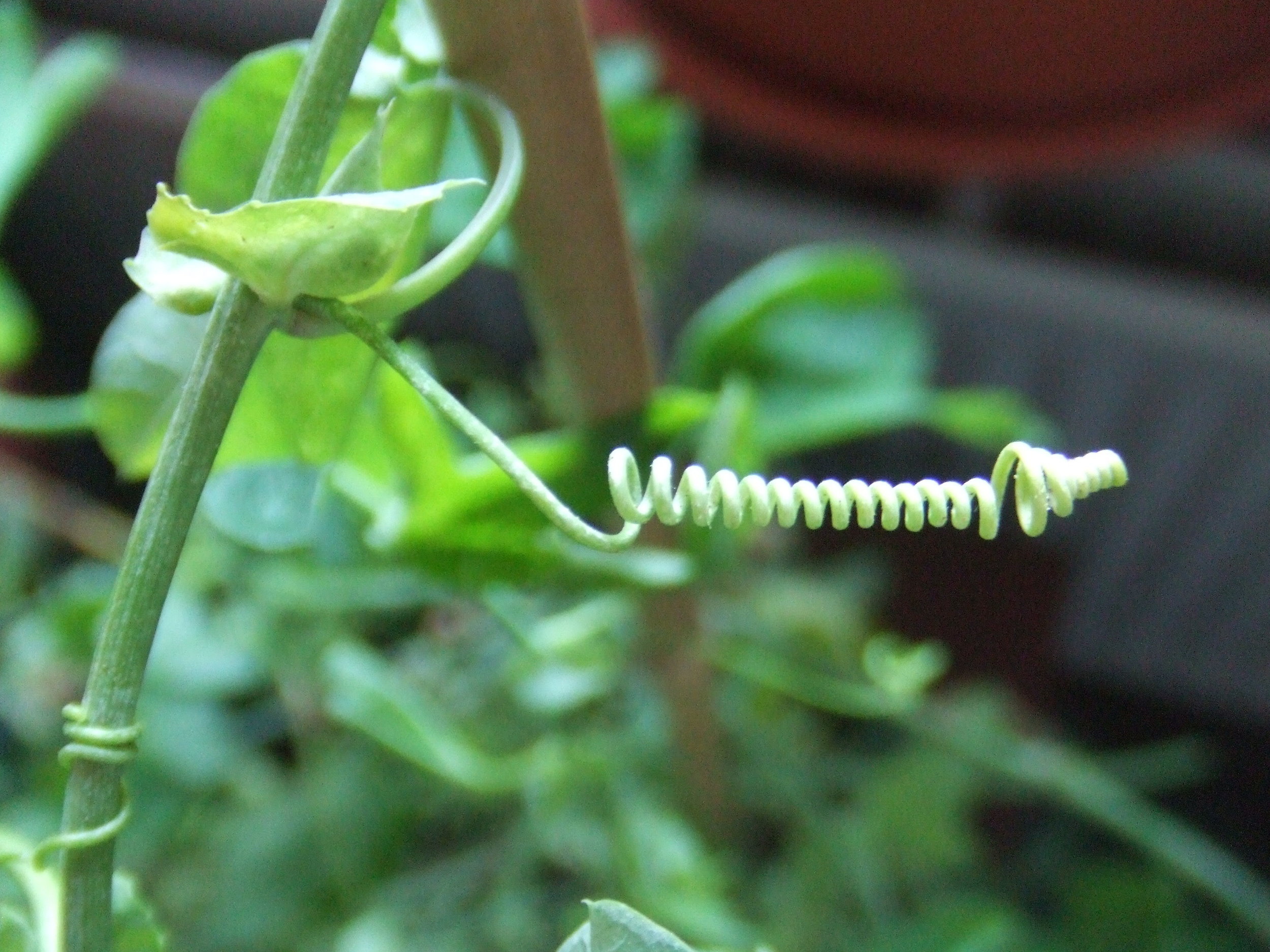
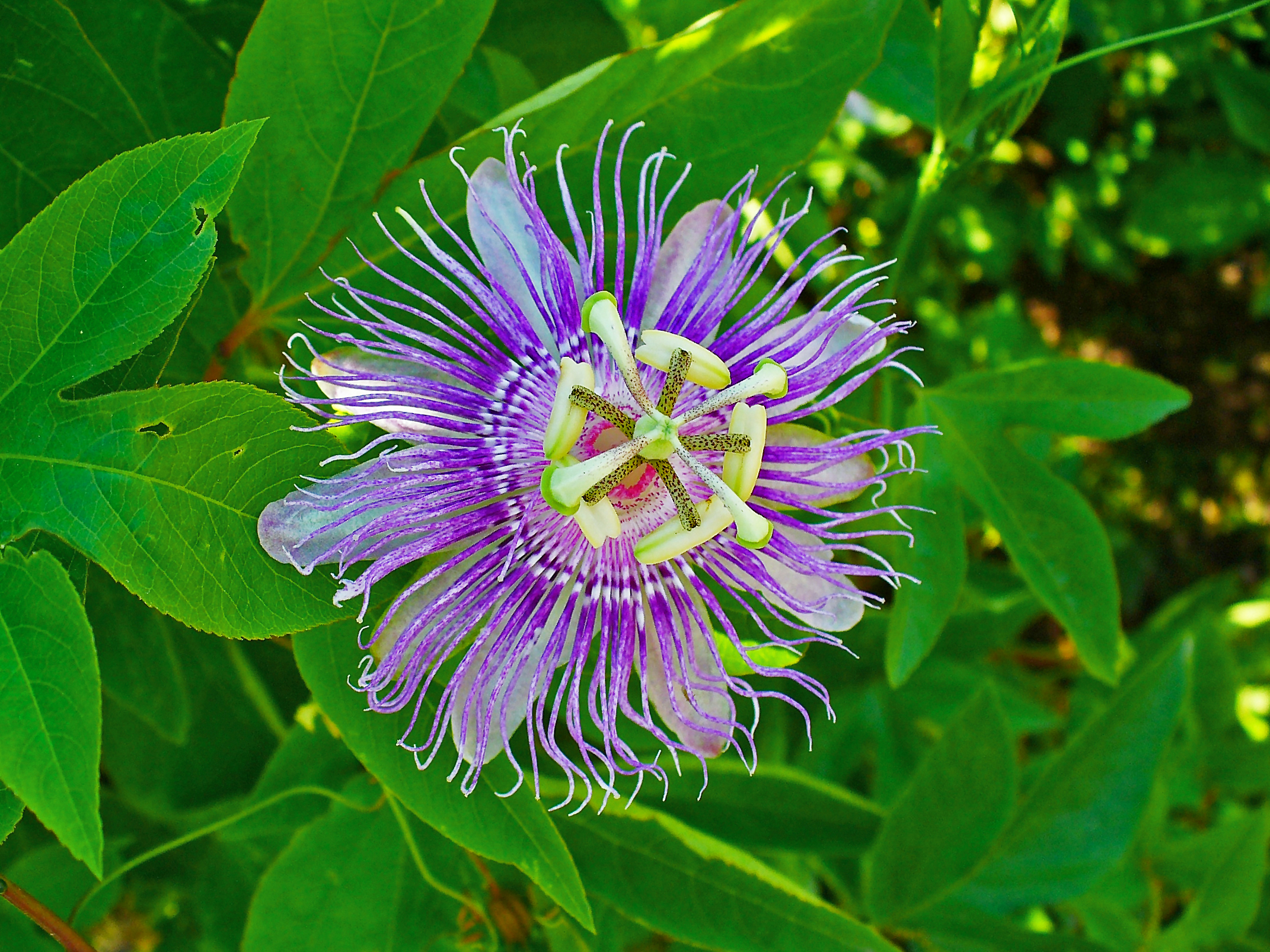
Photo credit: Wikimedia Commons
The upper parts of passionflower — the leaves, stems and flowers — are also a common remedy for insomnia and sleep issues, acting as a mild sedative. Many herbalists like to recommend it for people who cannot let go of their endless thoughts at night, preventing them from getting sound sleep. Passionflower helps the body and mind to wind down a notch, letting go of nervous energy in order to more fully relax. Likewise, because of its calming and anti-spasmodic properties it is often used for tension and pain. It can be particularly useful for menstrual cramping and PMS crankiness. (Again, think of a grasping tendril relaxing its coil just a bit.)
On a personal note, much of my experience of passionflower comes from being around the living plant. Many years ago I worked in a greenhouse that was full of hundreds of different species of plants from all over the world. I remember one particular week when I was feeling stressed and restless because I was wanting to do and be more than what I was currently doing and being! I felt drawn to the potted passionflower vine that we had growing in the greenhouse. At the time I did not know of its herbal uses but I felt compelled to be near its beauty — perhaps because I was reminded of my childhood experiences with the plant — and I even spent some time drawing it. I discovered that to me this beautiful creature represents a balance between seeking/longing/reaching (represented by its outstretched, grasping vines) and exquisite poise and grace (represented by its otherworldly flowers). For me, simply being around the passionflower and spending quiet, still moments with it helped to calm my own longing, anxiety and restlessness, making me feel more at ease with the present moment.
HOW TO USE PASSIONFLOWER:
The aerial parts of Passiflora incarnata are used — leaves, stems and flowers — which can then be made into tea or tincture.
Use 1 - 2 teaspoons of the dried leaf in 8 oz hot water for tea; steep for 10 minutes. Passionflower blends well with other relaxing herbs such as lemon balm, lavender, chamomile, skullcap and California poppy.
The tea is not palatable to every tongue, so the tincture is also a good option, especially for sleep issues. When using the tincture start with 1/2 of a dropper-full 30 minutes before bed and increase the dosage from there if needed.
Cautions: Avoid passionflower in combination with other pharmaceutical sedatives, and do not use if pregnant. Also avoid this herb with low blood pressure. As with all herbs, please remember that every body is unique, and we all respond differently.
HOW TO GROW PASSIONFLOWER:
My friend Jenny Hauf, herb grower extraordinaire and owner of Muddy River Herbals was kind enough to write up some growing instructions for those of us who’d like to grow Passionflower this summer:

This sun-loving semi-succulent vine prefers relatively dry soils and can grow up to eight feet tall, so be sure to provide it with a trellis. While Passiflora incarnata is the hardiest of the passionflowers, New England specimens benefit greatly from a protected space. South-facing walls and stone fences provide ideal habitat, as they trap and conserve heat and create a microclimate warmer than the surrounding area. Passionflower should be heavily mulched to insulate the roots from our often harsh winters. It will struggle and be at risk of winterkill if planted in heavy clay soil, frost pockets, or exposed areas of the garden.
To grow from seed, soak in warm water for two to seven days, scarify by nicking with a knife, and keep in a warm, well-lit place until seeds germinate. (An especially sunny window by a radiator works nicely.) Sow at least double what you hope to plant in your garden, as the seeds have a low rate of viability. It's a finicky germinator, taking between a few weeks and a few months to sprout, so be patient. While passionflower isn’t the simplest of plants to grow, especially here in New England, if you have the right space and enough love to give it you will be rewarded with its powerful, storied, and mesmerizing medicine.
By the way, Jenny’s medicinal herb CSA will start delivering fresh herbs this summer at Cambridge Naturals! This is a wonderful way to get your hands on some lovingly-grown and potent local herbs. More details can be found on her website: http://www.muddyriverherbals.com/csa/
Steph Zabel is an herbalist and educator based in Somerville, MA who helps urban dwellers connect with the plant world. She teaches herbal classes, is available for individual wellness consultations, and is also the founder of HERBSTALK, Boston’s community herbal conference.
Learn more about her work at: www.flowerfolkherbs.com and www.herbstalk.org.
References:
http://chestnutherbs.com/passionflower-ecology-cultivation-botany-and-medicinal-and-edible-uses/
https://umm.edu/health/medical/altmed/herb/passionflower
The Earthwise Herbal: A Complete Guide to New World Medicinal Plants by Matthew Wood
This blog post — Passionflower: Passiflora incarnata — is for general health information only. This blog post is not to be used as a substitute for medical advice, diagnosis or treatment of any health condition or problem. Users of this Web site should not rely on information provided on this Web site for their own health problems. Any questions regarding your own health should be addressed to your own physician or other healthcare provider.
THYME: Thymus vulgaris Lamiaceae
By Steph Zabel
Herbalist, Ethnobotanist and Educator
Pungent, aromatic thyme is one of those plants that we all know — and have eaten in one dish or another — but tend to forget about when it comes to herbal uses. It is similar in some regards to sage in that it is an important culinary herb, used for centuries by the home cook. However, there is much more to thyme than meets the eye…
By Steph Zabel
Herbalist, Ethnobotanist and Educator
Pungent, aromatic thyme is one of those plants that we all know — and have eaten in one dish or another — but tend to forget about when it comes to herbal uses. It is similar in some regards to sage in that it is an important culinary herb, used for centuries by the home cook. However, there is much more to thyme than meets the eye…

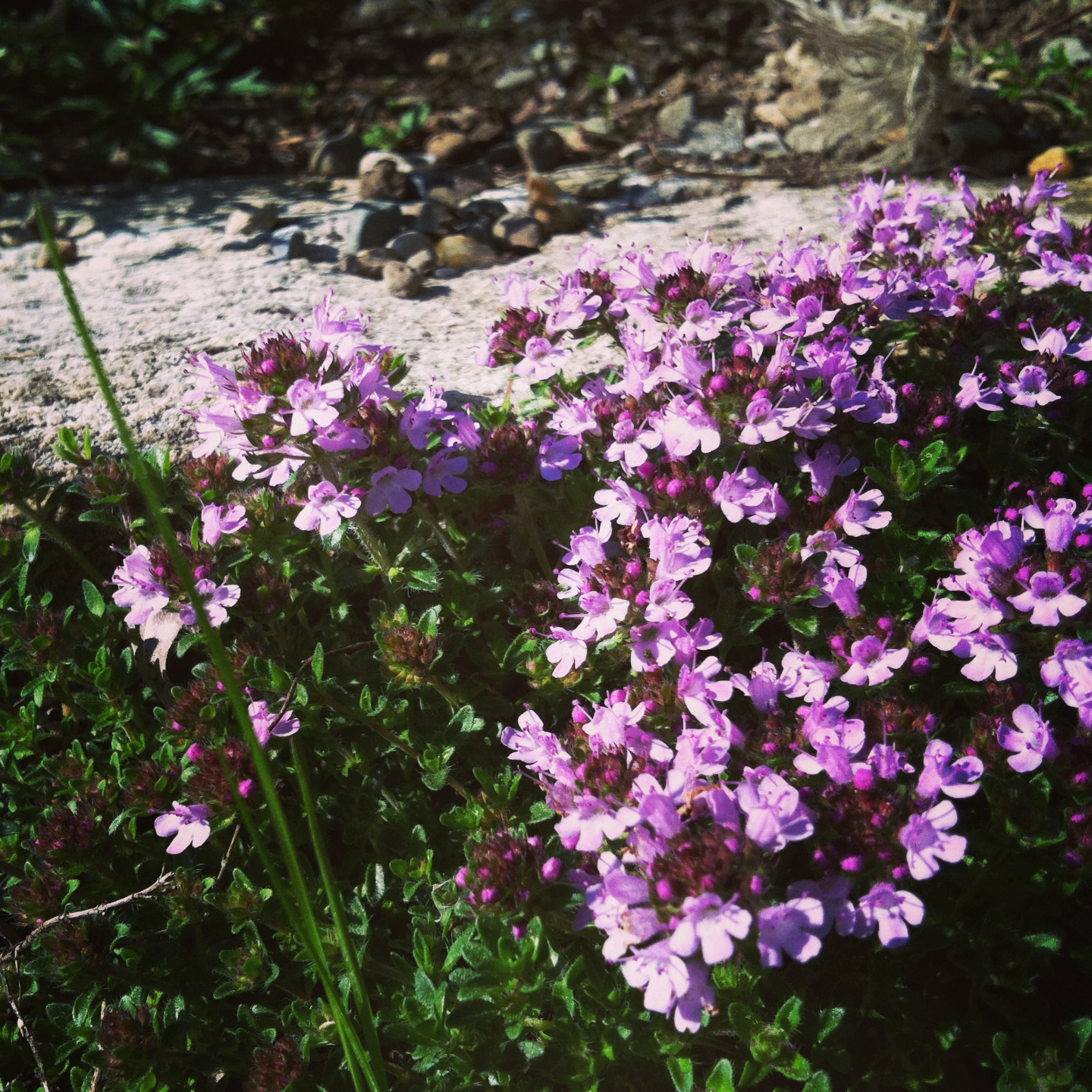
This spritely little plant originated in the Mediterranean and is one of the oldest herbs with documented use. Due to its preservative and antiseptic properties the Egyptians used it for embalming their dead. Greek soldiers bathed in thyme before war to inspire courage. Amongst the Romans it was exchanged as a sign of respect, and burned as an incense to purify sacred spaces. As a powerful natural antiseptic it has been used throughout history to sterilize wounds, preserve meat, and keep away pests and rodents.
And of course we know thyme as an herb of cooking. What would the famous Herbes de Provence be without it? Thyme is a wonderful addition to meat and heavier dishes; it helps support the digestion of rich and fatty foods. I like to add lots of thyme to my chicken broth, which I simmer for hours and hours in the winter months. (see recipe below)
Much of the power of thyme lies in its essential oil content. This oil is detected when you crush the fresh or dried leaves between your fingers, which release a pungent aroma. The oil, called thymol, is responsible for much of the plant’s action on the human body; it possesses very strong antiseptic and antimicrobial properties. In this regard thyme is useful for getting rid of pests, parasites and pathogens that effect our health. It can kill fungus, mold, yeast, viruses and bacteria. It is especially good for helping to clear infections in the digestive tract and throughout the respiratory system. It is a wonderful herb to turn to when you are coming down with the first signs of a cold. Thyme will enhance immune function and help you to overcome an infection more quickly. I love thyme for coughs, sore throat, and clearing up congestion. To get the benefits, you can drink it as a tea or you can do an old-fashioned steam.

Franz Eugen Köhler, Köhler's Medizinal-Pflanzen
Beyond its lovely healing virtues, thyme also has much folklore that surrounds it. In particular, it was believed to be a plant that fairies like to reside in. (I have to admit, if I were a fairy, I would most certainly like to live in a house made of thyme…and wear clothes made with dainty thyme flowers.) Not only was thyme believed to attract fairies, it also was thought to help you see them as well. I recently came across a recipe from the 1600s that involved making an oil infused with thyme and a few other plants. This oil was to be steeped in the sun for three days, after which it would “enable one to see the fairies.” So, you know what I will be making this summer…
If fairies don’t interest you, perhaps bees do? Thyme is beloved by our buzzing friends, so plant lots of thyme wherever you have room. It is a very easy plant to grow and does just fine in a small container if you don’t have a garden. Mine thrives quite happily in a small window box. Just give it plenty of full sun and it will delight you with its uplifting scent and charming flowers all summer long.
HOW TO USE THYME:
To make thyme tea: add 1/2 teaspoon of dried leaves per 1 cup of water; let steep 5 to 10 minutes and add honey if desired.
Infuse fresh thyme leaves into raw honey and eat by the spoonful, or stir into tea.
For colds and upper respiratory congestion use an old fashioned steam: add a small handful of dried thyme leaves to a big pot of water and bring it to a boil. Then turn off the heat, place a towel over the head to catch the steam, and lean over and breathe in the herbal vapors for as long as you can.
Please do not use the essential oil of thyme internally – it is highly concentrated and very powerful. And for external use, all essential oils should be diluted in a carrier oil such as olive oil.
RECIPE: Chicken Broth with Thyme and Black Pepper
In your largest cooking pot combine the following:
The bones, skins and leftover of one whole roasted chicken
1 - 2 chopped onions
2 chopped carrots
2 sticks chopped celery
a small bunch of fresh parsley
a handful of calendula flowers*
1 tablespoon black peppercorn, crushed*
2 tablespoons dried thyme leaves*
2 tablespoons apple cider vinegar (to draw out the minerals from the chicken bones)*
*You can find these ingredients at Cambridge Naturals
Cover everything completely with water. Bring to a boil. Skim off any scum that arises. Lower to a rolling simmer, partially cover and let cook for at least 4 hours, up to 48 hours. Add more water as needed.Strain out all the ingredients and store the broth you will use within the week in a glass storage container. Freeze the rest.
Steph Zabel is an herbalist and educator based in Somerville, MA who helps urban dwellers connect with the plant world. She teaches herbal classes, is available for individual wellness consultations, and is also the founder of HERBSTALK, Boston’s community herbal conference. Learn more about her work at: www.flowerfolkherbs.com and www.herbstalk.org.
References:
https://www.botanical.com/botanical/mgmh/t/thygar16.html
http://cms.herbalgram.org/herbalgram/issue80/article3352.html?ts=1455131460&signature=b2e3e53a5f262eea4d6dbf7b03a422db
http://www.history.com/news/hungry-history/a-brief-history-of-thyme
https://en.wikipedia.org/wiki/Thymol
Beautiful Burdock Root: Arctium lappa
By Steph Zabel
Herbalist, Ethnobotanist and Educator
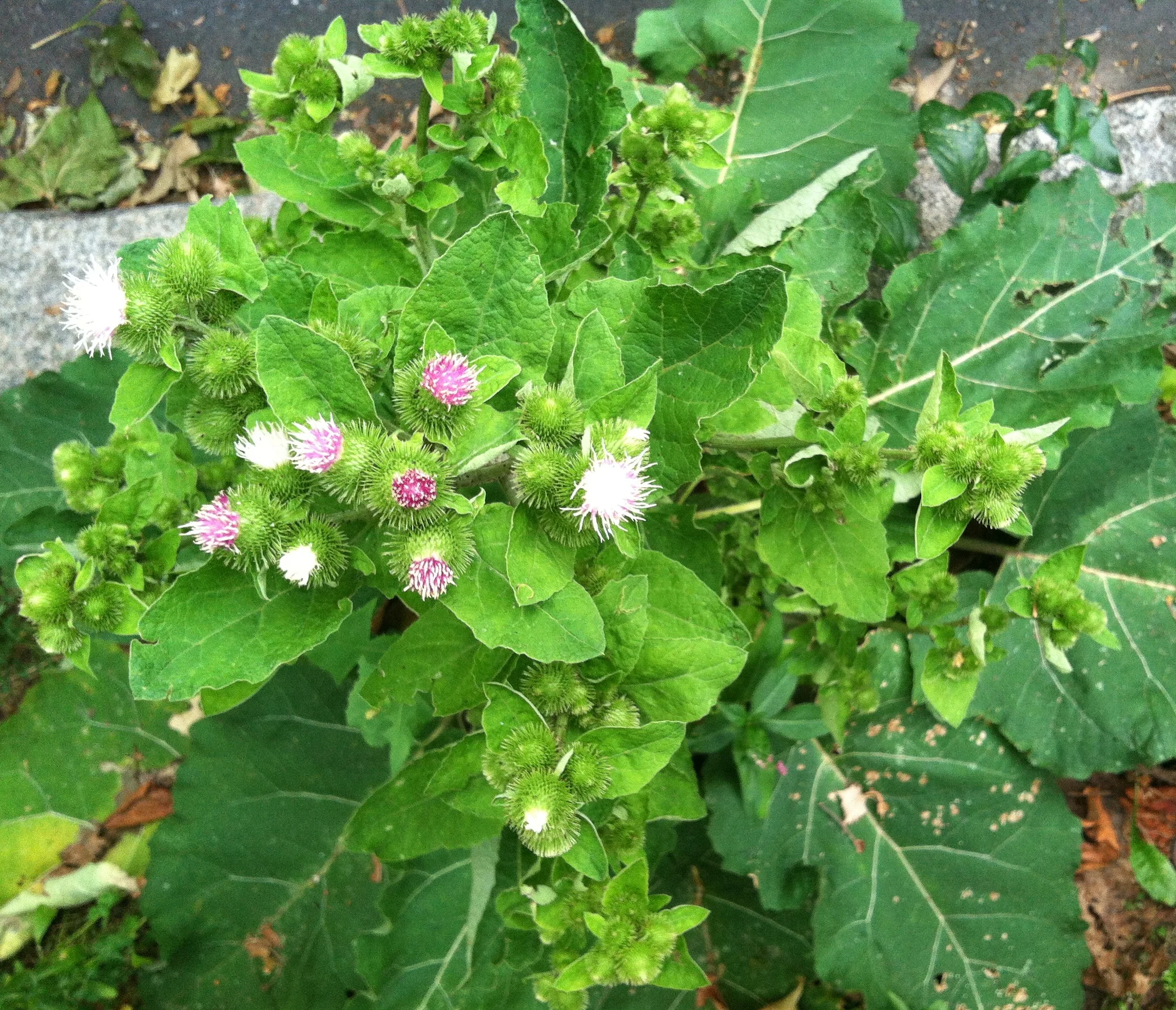
Burdock is a beautiful, large-leafed plant that pops up in areas where humans live. You’ve seen it growing around Cambridge and Somerville — I’m certain of it!
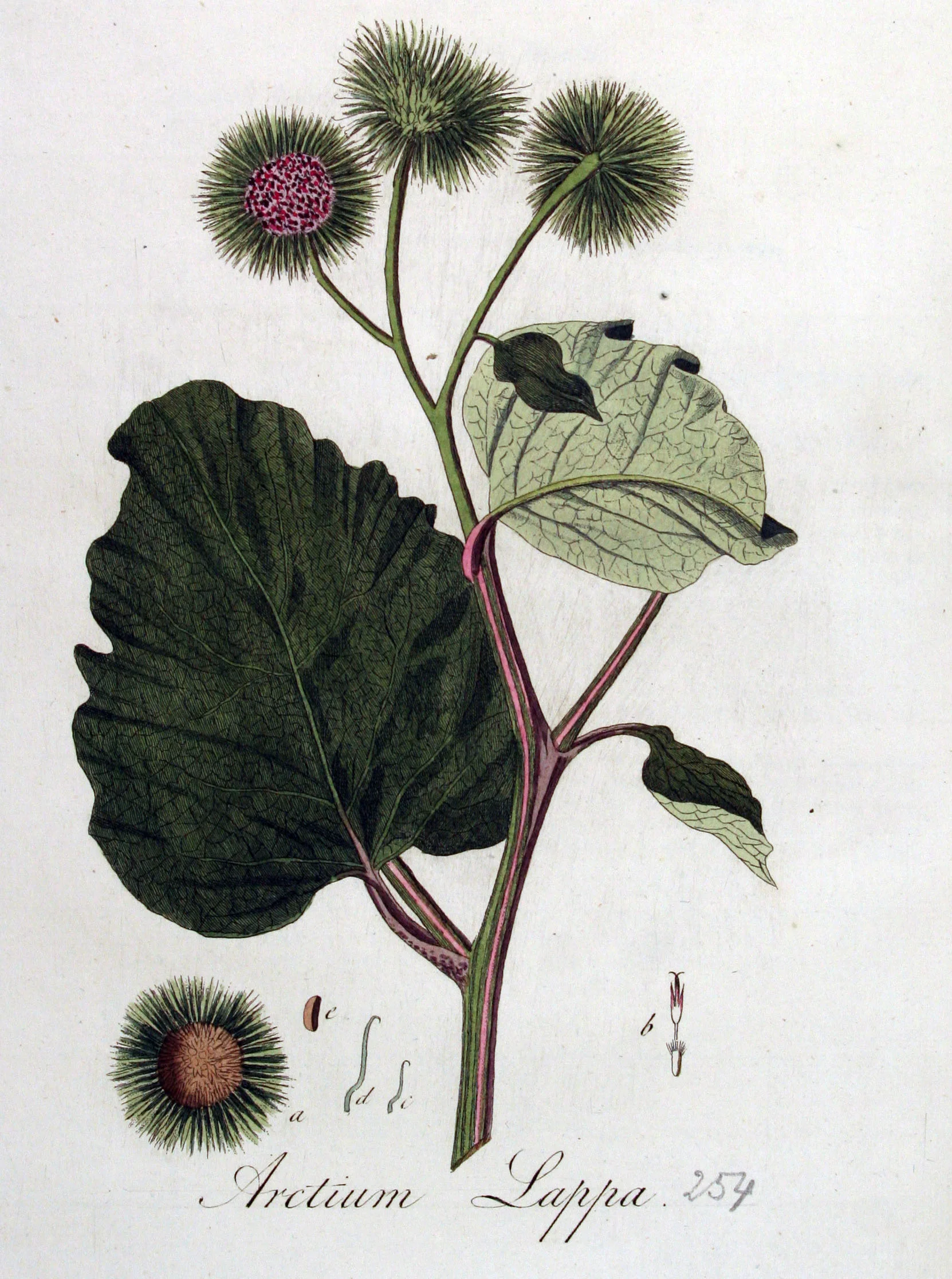
Burdock is generally called a “weed” since it likes to grow in places where it was not planted. Often overlooked, it is actually quite a lovely plant, when you take the time to admire it. The bright magenta flowers could easily be mistaken for a kind of thistle, and burdock is, in fact, closely related to thistles. The flowers are covered with prickly burrs, which interestingly were the inspiration behind the invention of Velcro! Get close to some of these clingy flowers and seed heads and you will see what I mean…
By Steph Zabel
Herbalist, Ethnobotanist and Educator
Burdock is a beautiful, large-leafed plant that pops up in areas where humans live. You’ve seen it growing around Cambridge and Somerville — I’m certain of it!
Burdock is generally called a “weed” since it likes to grow in places where it was not planted. Often overlooked, it is actually quite a lovely plant, when you take the time to admire it. The bright magenta flowers could easily be mistaken for a kind of thistle, and burdock is, in fact, closely related to thistles. The flowers are covered with prickly burrs, which interestingly were the inspiration behind the invention of Velcro! Get close to some of these clingy flowers and seed heads and you will see what I mean…
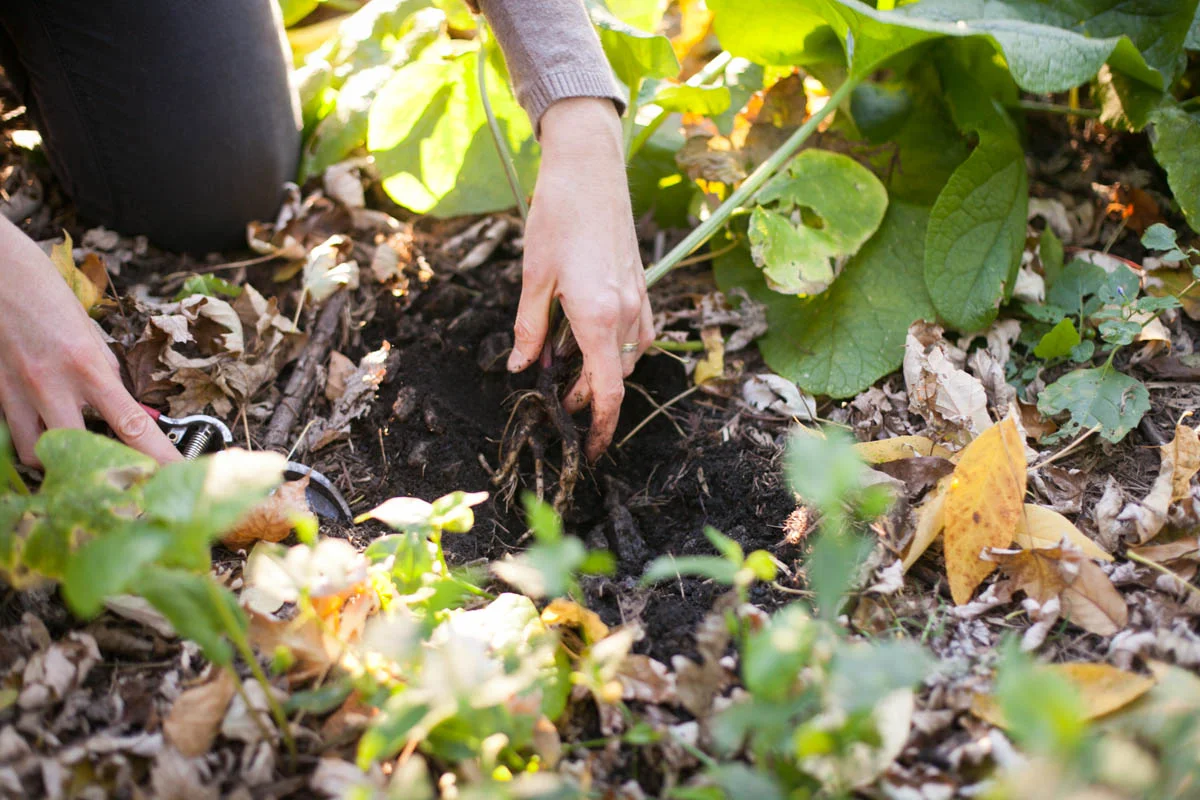
Burdock is a resourceful creature and can thrive in places where many other plants cannot. Part of its tenacity and strength is due to its long taproot, which burrows deeply down into the earth. With this advantage burdock can reach precious micro-nutrients that are often inaccessible to shallow-rooted plants.
Herein lies much of burdock’s goodness: Because of its deep earth diving, the roots contains many nutrients and minerals, as well as inulin, a special kind of storage carbohydrate (prebiotic). Inulin happens to be wonderful for the human digestive tract because it feeds and nourishes our beneficial gut flora. Taking burdock root is a good idea when there is any sort of digestive issue, especially when the good gut flora needs some support.

When taken as food, tea or tincture, burdock (slowly) acts upon the digestion and liver. It helps the system to better digest, and assimilate fats and oils — these are then more easily distributed to the skin, hair and internal tissues. Burdock is often a popular choice for helping resolve any sort of eruptive skin problem such as acne, rashes, or eczema. I will often pair it with red clover to help support the removal of waste products that may be improperly eliminating through the skin instead of through other channels. Traditionally this cleansing action led burdock to be known as a “blood purifier” because it helps to detoxify the body and blood by stimulating the release of waste products from the cells.
Burdock root is a gentle and nutritive tonic that helps to restore one’s natural energy and to overcome states of depletion. Not that long ago it was also used as a natural aphrodisiac! However, one important thing to know about burdock is that although it can have a very deep and profound effect on the body, it works slowly and must be taken with consistency over time. A few doses of burdock will not do the trick — this is an herb that needs to be used with commitment over several months. In exchange it will show you its ability to nourish depleted bodies, provide increased energy, and improve the function of the digestive system. Judith Berger — one of my favorite herbal writers — states, “The root’s style is almost tortoise-like as it patiently wades through tired organs, pulling poisons, chemical residues, and contaminants which slow down the lymphatic, digestive, and urinary organs.”
If you are looking to harvest your own burdock once the growing season returns, keep in mind that it is a biennial. Be sure to gather one-year-old plants in the fall, or two-year-old plants in the spring, i.e., any time before it has flowered. You want the energy of the root to still be underground rather moving upwards into the flowers and seeds.
HOW TO USE:
There are many ways to enjoy the sweet and earthy taste of burdock. You can eat the fresh or cooked roots, take it as a tincture, or drink it as a tea. If taking it as a tea, it will need to be simmered on the stove in order to draw out all of its benefits. Add 1 heaping tablespoon of the dried root to 1.5 cups of water in a small saucepan. Bring to a boil, then reduce to a simmer, cover with a lid, and let this cook for 15 to 20 minutes. Then strain and drink.
Another wonderful way to use nutritive burdock root is to steep it in apple cider vinegar. Vinegar is an excellent medium for drawing out the mineral contents of plants. Place 2 to 3 tablespoons of the dried root (or twice this amount of the chopped fresh root) in an 8 oz. glass jar. Cover with apple cider vinegar and let this mixture steep at room temperature for 2 to 3 weeks. Then strain out the roots, place the remaining liquid in a clean, dark bottle, and use this earthy mixture on vegetables or salads. I like to store my herbal vinegars in the fridge for the longest shelf life. Use up within 6 months.
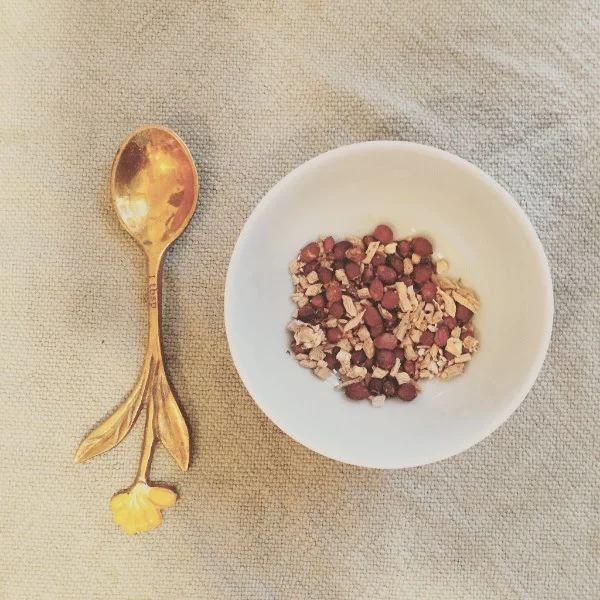
Root & Berry Tea
This is a nourishing, grounding and earthy-sweet tea for chilly days. This simple trio of berries and roots will warm your heart and spirit
Blend together:
4 Tblsp. hawthorn berries*
3 Tblsp. codonopsis root, dandelion root* or astragalus root*
1 Tblsp. burdock root*
*You can find these herbs in the bulk section at Cambridge Naturals!
Place 2 heaping Tablespoons of this mixture in 1.5 cups of water in a small saucepan. Bring to a boil then lower the heat to a simmer, cover, and let cook for 15 to 20 minutes. Strain and drink. This recipe will make enough for 3-4 servings.
Steph Zabel is an herbalist and educator based in Somerville, MA who helps urban dwellers connect with the plant world. She teaches herbal classes, is available for individual wellness consultations, and is also the founder of HERBSTALK, Boston’s community herbal conference. Learn more about her work at: www.flowerfolkherbs.com and www.herbstalk.org.
References:
https://umm.edu/health/medical/altmed/herb/burdock
http://www.botanical.com/botanical/mgmh/b/burdoc87.html
http://www.woodherbs.com/Burdock.html
http://www.herbcraft.org/burdock.html
Herbal Rituals by Judith Berge