
The Naturalist Blog
*
The Naturalist Blog *

Book Review: Fat Chance: Beating the Odds Against Sugar, Processed Food, Obesity, and Disease
Book By Dr. Robert Lustig
Reviewed by Rosalind Michahelles
In FAT CHANCE Dr. Lustig analyzes sugar (meaning, carbohydrates generally, glucose and fructose) scientifically, psychologically, and sociologically. He explains the subject from different perspectives:
• How we digest, use, and store the sugars in our diet
• Why sugars are addictive and hard to forego
• And what our society does to encourage their consumption
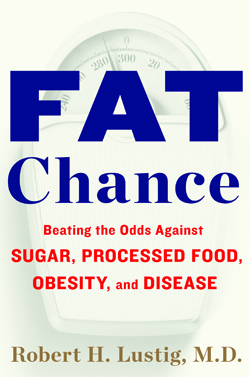
Book By Dr. Robert Lustig
Reviewed by Rosalind Michahelles
In FAT CHANCE Dr. Lustig analyzes sugar (meaning, carbohydrates generally, glucose and fructose) scientifically, psychologically, and sociologically. He explains the subject from different perspectives:
• How we digest, use, and store the sugars in our diet
• Why sugars are addictive and hard to forego
• And what our society does to encourage their consumption
This book is also a call to action because he feels that of all the possible dietary approaches to better national health, reducing sugar is the most “actionable.” We ought to be able to get Coca-Cola out of the schools and high-sugar juices off the lists approved by USDA for the food subsidy programs SNAP and WIC. The science of digestion is necessarily complex so as to equip us for a variety of potential challenges to our survival.
A key to hunger and fat storage is the balance between two independent hormones – insulin and leptin – that share the same ‘signaling cascade’ although they bind to separate receptors. What this means is that when insulin levels are chronically high leptin cannot signal satiety, which is leptin’s job.
With no feeling of satiety, the eater goes on eating. Insulin is usually raised by eating refined, high-glycemic starches and sugar. However, there are also drugs that increase insulin levels, among them steroids, anti-psychotics, and oral hypoglycemic diabetes drugs (p.82).
The kind of sugar called fructose, found in vegetables and fruit, has a somewhat different path from that of glucose. Because it doesn’t enter the bloodstream as quickly, it is less immediately disrupting to diabetics. However, too much spells trouble. The book elucidates the havoc that fructose can wreak.
One result of a liver over-dosed with fructose is insulin resistance, which misguidedly triggers the pancreas to produce more insulin and that leads to more fat accumulation and obesity. When fat accumulates in the liver, it exports triglycerides — and high serum triglycerides have the highest correlation with heart disease according to standard blood tests. Besides obesity and heart disease, the author also tracks the high fructose trail to cancer and dementia.
The book develops Dr. Lustig’s conviction that sugar in all its forms is an addictive and that category includes alcohol, cigarettes, caffeine, and certain drugs. Of seven criteria for establishing addictive status, sugar rings all the bells in the way that, say, salt or fat do not: tolerance (needing more for the same effect), withdrawal, bingeing, attempts to quit, craving, life disruption, and continued use all the same. Are you skeptical about the opiate effect of sugar? Consider Sweet-Ease, “a sugar solution into which hospitals dip pacifiers for newborn boys undergoing circumcision, to reduce the pain of the procedure.”
If you are reading this you may be wondering what diet or approach to menu planning would be best for you. Dr. Lustig makes it clear that reducing sugar and refined starches is important for everyone. Beyond that he says “Your insulin profile is the most important factor in determining what diet approach works best for you.” If your pancreas produces a lot of insulin, then choose a low-glycemic diet. If you are insulin resistant, then choose a low carbohydrate diet. If your insulin resistance is from genetic inheritance, go for the low fat diet.
The book ends with a section on public advocacy. Where is sugar being promoted and how? Where and how can concerned people like you and me intervene? This probably has to start at the grassroots level as, indeed, it has in some towns and cities. Although the public costs of sugar consumption are high, a sugar tax looks unlikely in the U.S. any time soon. But consider the precedents in curbing fast-food calories: New York City requires restaurant menu labels and San Francisco has banned toys in fast-food orders.
This book requires an attentive and motivated reader, despite its folksy tone, because the subject is a complicated and demanding one for a non-scientist. However, reading it repays the effort, as the problems of sugar consumption are very serious for the society as a whole and for certain individuals in particular. If we are not one of those, we surely know and care about someone who is.
Fat Chance is currently available under two titles:
Fat Chance: Beating the Odds Against Sugar, Processed Food, Obesity, and Disease (Hudson Street Press – US version) and Fat Chance: The Bitter Truth about Sugar (Fourth Estate, London, 2013)
………………….
Rosalind Michahelles is a Certified Holistic Health Counselor in Cambridge.
For questions about this essay or related issues please call 617-491-3239 or visit www.nutrition-matters.info.
Book Review: Good Calories, Bad Calories & Why We Get Fat
Good Calories, Bad Calories & Why We Get Fat and What To Do About It
By Gary Taubes, Correspondent for Science magazine
Reviewed by Rosalind Michahelles
July 26, 2013
Gary Taubes, science writer for Science magazine and other publications, including the New York Times Magazine, has written two books that cover the same subject.
The first one, Good Calories, Bad Calories is more compendious and more technical in following the relevant scientific research into what makes people fat. After enough readers had asked Taubes for a simpler, more condensed version for equally motivated but less scientifically trained readers he wrote Why We Get Fat.
Good Calories, Bad Calories & Why We Get Fat and What To Do About It
By Gary Taubes, Correspondent for Science magazine
Reviewed by Rosalind Michahelles
July 26, 2013
Gary Taubes, science writer for Science magazine and other publications, including the New York Times Magazine, has written two books that cover the same subject.
The first one, Good Calories, Bad Calories is more compendious and more technical in following the relevant scientific research into what makes people fat. After enough readers had asked Taubes for a simpler, more condensed version for equally motivated but less scientifically trained readers he wrote Why We Get Fat.

The author was surprised by some of what he uncovered in his search. The biggest surprise was that some calories are more fattening than other calories – surprising because we have been hearing statements like “a calorie is a calorie” as if all were treated equally in the body. Taubes explains clearly how carbohydrates are “uniquely fattening.” Why? Because of insulin, that enzyme made famous by diabetes. Among insulin’s several roles are those that contribute to adiposity: the regulation of blood sugar and the storage of fat. He quotes one Harvard professor this way:
Carbohydrates → insulin → fat storage
What is a carbohydrate? Before going further, it’s important to remember what a carbohydrate is. Scientists call them saccharides because they are essentially sugars. These sugars in our diets come mostly from plants in the form of sugar, starch, and fiber. Milk also provides sugar in the form of lactose. The universe of ‘carbs’ therefore includes more than starchy vegetables (potatoes) and grains (wheat, rice). It also includes our everyday fruit and vegetables. An apple, though, is only about 10-12% carbohydrate by weight, most of it being water. Bread, on the other hand, is nearly 50% carbohydrate by weight.
Now back to the all-important insulin, which the pancreas produces primarily in response to carbohydrates. “The more carbohydrates we eat, and the easier they are to digest and the sweeter they are, the more insulin we will secrete, meaning that the level of it in our bloodstream is greater and so is the fat we retain in our fat cells.” (WWGF, p.10) The kicker in this situation is that the more insulin in our veins, the hungrier we feel and the more likely we then are to go back for a second piece of cake, or to want lunch early, or to suffer a snack attack. Just as blood sugar requires insulin, so does insulin require blood sugar. Without it, the insulin signals hunger in its search for more glucose.

Taubes makes much of the fact that some people – probably for reasons of genetics – tend to fatten more easily than others, even if they eat the same meals. Once fatter, they must eat more to maintain energy levels. They eat because they are fat; they are not fat because they “over” eat. The way for them to lose weight is to provoke an insulin deficiency and the way to do that is to eliminate carbohydrates from the diet. Consider the Eskimos – caribou, seal, cold-water fish, blubber. That diet, devoid of fruit and vegetables, consisted of about 25% protein and 75% fat. Before the arrival of Western food, Eskimos did not apparently suffer from either obesity or diabetes. Perhaps you don’t see yourself as an Eskimo; perhaps a DuPont executive seems closer to home. In the 1940s twenty overweight DuPont employees went on a diet averaging 3,000 calories a day with no more than 80 calories of carbohydrate. They lost an average of two pounds a week. (WWGF, p. 157)
Currently, standard advice for weight loss in the U.S. is (a) to eat less and (b) to exercise. Taubes’s research maintains that, healthy though exercise may be, it won’t lead to weight loss but rather to increased hunger and even possibly weight gain between exertions. “The belief in physical activity as a method of weight control is relatively new…and it has long been contradicted by the evidence.” (GCBC, p.259) As for eating less, starvation diets lead to lower energy levels, stress-related fat storage, and poor morale. They tend not to work.
What does, however, work for weight loss, according to Taubes, is an insulin deficiency because “when insulin levels go up, we store fat. When they come down, we mobilize the fat and use it for fuel.” By now, you may well be thinking of Dr. Atkins or the trendier paleo-diet, both of which severely restrict carbohydrates. A diet with no or almost no carbohydrates is called a ketogenic diet in which “the liver increases it synthesis of molecules called ketone bodies, and these supply the necessary fuel for the brain and the nervous system.” (GCBC, p.319) (N.B. Ketosis is healthy and happens every night when we’re asleep and fasting; keto-acidosis, by contrast, poses a health crisis for diabetics.)
If you were to follow such a diet and strictly reduce carbohydrates, what would you replace them with? As protein is not to be more than a quarter or maybe a third of the diet, that means, as with the Eskimos, the rest will be fat — and what will your doctor say to that?! We have been in low-fat mode for decades now (albeit with questionable results) but that being the prevailing belief, it is very hard to eat the cream cheese and skip the bagel, instead of the other way around. However, here are some sobering observations. One is that the serum fats that correlate most strongly with heart disease are triglycerides – which are made in the liver from dietary carbohydrates. Oh, yes, and do you want your HDL cholesterol to go up, as the doctor recommends? Then reduce your carbohydrate intake as HDL goes up when carbs come down. “If you’re currently eating cereal, skim milk, and bananas and switch instead to eggs and bacon, your HDL cholesterol will go up, and your heart attack risk will go down.” (WWGF, pp. 187-8)
Besides making the case for weight loss and diabetic treatment by reducing carbohydrates, Taubes also reviews the case for similarly reducing the risk of both Alzheimer’s and cancer. Good Calories, Bad Calories dedicates all of chapter 13 to these issues. High insulin levels tend to produce amyloid proteins in the brain and they are implicated in Alzheimer’s (GCBC, p. 208). As for cancer, since “tumors will burn perhaps thirty times as much blood sugar as normal cells,” depriving them of glucose should have an inhibiting and salutary effect. (GCBC, p. 213).
Given the proposed change in diet, let us not forget about vitamins, especially vitamin C. If the meat and fish and eggs we eat come from free ranging animals, they will provide the vitamins at second hand, so to speak. The vitamin deficiency diseases that have bedeviled sections of the human population resulted from cereal-based diets – pellagra from northern Italian and southern U.S. populations primarily subsisting on corn, for instance.
Vitamin C, in turns out, must fight with sugar for entry into cells. “Glucose and vitamin C compete in the cellular uptake process…[but] glucose is greatly favored in the contest.” (GCBC, p325) Your choice – carbs or vitamin C?
Taubes’s two books are both very convincing in their conclusions. Although we can make allowances for individual differences, the accumulation of evidence presented here shows that:
• Dietary fat is not especially fattening;
• Carbohydrates, particularly refined sugar and starch, are more fattening;
• Carbohydrates provoke insulin;
• Insulin leads to fat storage, obesity, and diabetes, and perhaps dementia and cancer; and, furthermore,
• Carbohydrates increase hunger.
Whether you want to change your diet or not, these books fully reward the reading of them. You will be better informed about what you are eating and how it is affecting you.
Rosalind Michahelles is a Certified Holistic Health Counselor
in Cambridge. For questions about this essay or related issues please call 617-491-3239 or visit www.nutrition-matters.info