
The Naturalist Blog
*
The Naturalist Blog *

Book Review: Fat Chance: Beating the Odds Against Sugar, Processed Food, Obesity, and Disease
Book By Dr. Robert Lustig
Reviewed by Rosalind Michahelles
In FAT CHANCE Dr. Lustig analyzes sugar (meaning, carbohydrates generally, glucose and fructose) scientifically, psychologically, and sociologically. He explains the subject from different perspectives:
• How we digest, use, and store the sugars in our diet
• Why sugars are addictive and hard to forego
• And what our society does to encourage their consumption
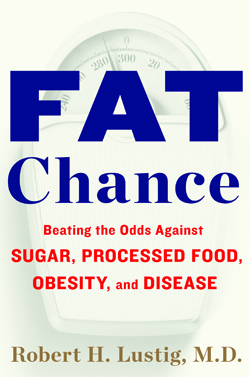
Book By Dr. Robert Lustig
Reviewed by Rosalind Michahelles
In FAT CHANCE Dr. Lustig analyzes sugar (meaning, carbohydrates generally, glucose and fructose) scientifically, psychologically, and sociologically. He explains the subject from different perspectives:
• How we digest, use, and store the sugars in our diet
• Why sugars are addictive and hard to forego
• And what our society does to encourage their consumption
This book is also a call to action because he feels that of all the possible dietary approaches to better national health, reducing sugar is the most “actionable.” We ought to be able to get Coca-Cola out of the schools and high-sugar juices off the lists approved by USDA for the food subsidy programs SNAP and WIC. The science of digestion is necessarily complex so as to equip us for a variety of potential challenges to our survival.
A key to hunger and fat storage is the balance between two independent hormones – insulin and leptin – that share the same ‘signaling cascade’ although they bind to separate receptors. What this means is that when insulin levels are chronically high leptin cannot signal satiety, which is leptin’s job.
With no feeling of satiety, the eater goes on eating. Insulin is usually raised by eating refined, high-glycemic starches and sugar. However, there are also drugs that increase insulin levels, among them steroids, anti-psychotics, and oral hypoglycemic diabetes drugs (p.82).
The kind of sugar called fructose, found in vegetables and fruit, has a somewhat different path from that of glucose. Because it doesn’t enter the bloodstream as quickly, it is less immediately disrupting to diabetics. However, too much spells trouble. The book elucidates the havoc that fructose can wreak.
One result of a liver over-dosed with fructose is insulin resistance, which misguidedly triggers the pancreas to produce more insulin and that leads to more fat accumulation and obesity. When fat accumulates in the liver, it exports triglycerides — and high serum triglycerides have the highest correlation with heart disease according to standard blood tests. Besides obesity and heart disease, the author also tracks the high fructose trail to cancer and dementia.
The book develops Dr. Lustig’s conviction that sugar in all its forms is an addictive and that category includes alcohol, cigarettes, caffeine, and certain drugs. Of seven criteria for establishing addictive status, sugar rings all the bells in the way that, say, salt or fat do not: tolerance (needing more for the same effect), withdrawal, bingeing, attempts to quit, craving, life disruption, and continued use all the same. Are you skeptical about the opiate effect of sugar? Consider Sweet-Ease, “a sugar solution into which hospitals dip pacifiers for newborn boys undergoing circumcision, to reduce the pain of the procedure.”
If you are reading this you may be wondering what diet or approach to menu planning would be best for you. Dr. Lustig makes it clear that reducing sugar and refined starches is important for everyone. Beyond that he says “Your insulin profile is the most important factor in determining what diet approach works best for you.” If your pancreas produces a lot of insulin, then choose a low-glycemic diet. If you are insulin resistant, then choose a low carbohydrate diet. If your insulin resistance is from genetic inheritance, go for the low fat diet.
The book ends with a section on public advocacy. Where is sugar being promoted and how? Where and how can concerned people like you and me intervene? This probably has to start at the grassroots level as, indeed, it has in some towns and cities. Although the public costs of sugar consumption are high, a sugar tax looks unlikely in the U.S. any time soon. But consider the precedents in curbing fast-food calories: New York City requires restaurant menu labels and San Francisco has banned toys in fast-food orders.
This book requires an attentive and motivated reader, despite its folksy tone, because the subject is a complicated and demanding one for a non-scientist. However, reading it repays the effort, as the problems of sugar consumption are very serious for the society as a whole and for certain individuals in particular. If we are not one of those, we surely know and care about someone who is.
Fat Chance is currently available under two titles:
Fat Chance: Beating the Odds Against Sugar, Processed Food, Obesity, and Disease (Hudson Street Press – US version) and Fat Chance: The Bitter Truth about Sugar (Fourth Estate, London, 2013)
………………….
Rosalind Michahelles is a Certified Holistic Health Counselor in Cambridge.
For questions about this essay or related issues please call 617-491-3239 or visit www.nutrition-matters.info.
Book Review: Vitamin K-2 and the Calcium Paradox: How a Little-Known Vitamin Could Save Your Life
By Kate Rheaume-Bleue (Collins, 2012)
Reviewed by Rosalind Michahelles
The paradox in the title refers to the fact that – according to the author’s research — dietary calcium, unaccompanied by vitamin K-2 may well end up in soft tissue like blood vessels rather than in bones and teeth. In other words, it may harden your arteries rather than strengthen your bones and your teeth. Apparently vitamin K-2 plays a crucial stimulating role where two proteins are concerned: one is osteocalcin, which pulls calcium into bones; the other is matrix gla protein (MGP) which pulls calcium out of soft tissue. Vitamin K-2 thus provides a twofold benefit.

By Kate Rheaume-Bleue (Collins, 2012)
Reviewed by Rosalind Michahelles
The paradox in the title refers to the fact that – according to the author’s research — dietary calcium, unaccompanied by vitamin K-2 may well end up in soft tissue like blood vessels rather than in bones and teeth. In other words, it may harden your arteries rather than strengthen your bones and your teeth. Apparently vitamin K-2 plays a crucial stimulating role where two proteins are concerned: one is osteocalcin, which pulls calcium into bones; the other is matrix gla protein (MGP) which pulls calcium out of soft tissue. Vitamin K-2 thus provides a twofold benefit.
What about the more famous vitamin K-1, you may be asking. K-1 – philiquinone – comes from plants like leafy green vegetables and is important in the blood clotting function. That is why patients on blood-thinners like warfarin are advised to avoid kale and spinach and such. Some K-2 will be made in the body from K-1 but by far the more important source is dietary. Good sources of K-2, according to the studies the author refers to, are (a) the fat of grass-fed animals, which means goose liver and some cheeses like Gouda and Brie, among other menu items and (b) natto, a Japanese soybean ferment. Natto is hard for most people to like on the first couple of tries. But those in Japan who eat it seem to have the strongest bones.
Vitamins A and D collaborate with K-2 in ways that allow one to pick up the slack when the other one is short. In this “sparing action” (p.201), sufficient vitamin A means less K-2 is needed. Cooperatively, vitamins A and D operate a “switch mechanism,” whereby a small amount of either guards against toxicity from too much of the other (p.203).
One unfortunate scenario has unfolded from taking generous supplements of calcium and vitamin D without the accompaniment of A and K-2. Vitamin D helps draw calcium from the intestines into the blood stream – but then what? Without the other vitamins it can lodge in arterial plaque, increasing the likelihood of heart problems. The coronary artery calcium test is one way to find out if that’s happening. Another potential problem is that kidney stones may form when excess calcium builds up in urine.
How to test for K-2 deficiency? One possibility is to test for inactivated osteocalcin in the blood. It will be in inverse relation to vitamin K-2, as K-2 is the principal activator of osteocalcin. If you do decide to take a supplement, be sure that all three vitamins are coming in, either through diet or pills. Vitamin K-2 comes in two flavors, so to speak. Menaquinone-4, which in nature comes from animals, is synthetic when in supplements. MK-7, on the other hand, comes from natto. The author, who is Canadian, says that MK-4 is less effective such that a larger and more frequent dose is recommended; MK-7 is thus the gold standard.
If you have problems with bones or teeth or arteriosclerosis or varicose veins or kidney stones, this interesting book is worth reading. One lesson I got from it – once again – is that food is our best medicine but when the food supply strays from nature we should look to supplements, but in moderation. Beef used to provide vitamin K-2 because cows ate grass; now that they eat corn and soy, etc., we may well need vitamin K-2 supplements to ward off osteoporosis, tooth decay, and heart disease.
—–
Rosalind Michahelles is a certified holistic health counselor in Cambridge. For questions about this essay or related issues please call 617-491-3239 or visit www.nutrition-matters.info
Antibiotic Resistance – and What to Do About It?
How do bacteria manage to overcome antibiotics? And, will herbs rather than pharmaceuticals ultimately help us more?
By Rosalind Michahelles
Penicillin famously killed off some staphylococcus aureus in a petri dish in the lab of Alexander Fleming in the late ‘20’s and by the time we entered WWII, it was available for treating our war wounded. Civilians soon followed and I happened to be an early beneficiary in May of 1947, hospitalized for earache as an infant. The first semi-synthetic antibiotic, methicillin, appeared in 1960. It took only four years for the first resistant bacteria to be identified: methicillin resistant staphylococcus aureas, or MRSA. MRSA and other antibiotic resistant bacteria, like clostridium difficile, have become a scourge not just in hospitals but also occasionally in the population at large.

How do bacteria manage to overcome antibiotics? And, will herbs rather than pharmaceuticals ultimately help us more?
By Rosalind Michahelles
Penicillin famously killed off some staphylococcus aureus in a petri dish in the lab of Alexander Fleming in the late ‘20’s and by the time we entered WWII, it was available for treating our war wounded. Civilians soon followed and I happened to be an early beneficiary in May of 1947, hospitalized for earache as an infant. The first semi-synthetic antibiotic, methicillin, appeared in 1960. It took only four years for the first resistant bacteria to be identified: methicillin resistant staphylococcus aureas, or MRSA. MRSA and other antibiotic resistant bacteria, like clostridium difficile, have become a scourge not just in hospitals but also occasionally in the population at large.
Jessica Snyder Sachs in her book Good Germs, Bad Germs: Health and Survival in a Bacterial World, starts her prologue with the story of a healthy, athletic teenage boy who gets what seems to be flu and is dead within a couple of days – from MRSA. There are such cases. She goes on to describe the history and development of antibiotics and then how the bacteria manage to defend themselves. When you think about it, it makes sense that they should be equipped to do so because, after all, they have been around a long time and have had to adapt to many situations and many hosts – like us – who offer many kinds of challenge.
Some of the ways bacteria have been observed protecting themselves from antibiotics are:
• Hiding “their surface proteins from the immune system inside a capsule made of polysaccharides;”
• Pumping the antibiotic out of the cell faster than it can get in, a system dubbed the efflux pump;
• Producing proteins that chemically render the antibiotic impotent; and
• Self-mutating so as to prevent antibiotics from binding to target enzymes or targets within the ribosome.
To be effective bacteria must respond en masse and they do this by using “a chemical language known as quorum sensing…to count their numbers, develop a critical mass, and then change their behavior in unison to carry out their task.” Beyond their inborn ability to protect themselves, they apparently also have the ability to communicate drug resistance once they have developed it – and not just to their own kind. They can do this across species, e.g., from enterococcus to staphylococcus. Their known methods are:
• Bacterial ‘sex’ via plasmids transmitted from bacterium to bacterium to “teach” antibiotic resistance;
• Transduction or “gene ferrying” from one bacterium to another to confer resistance;
• Transformation, during which the ability to encapsulate is transferred from bacterium to bacterium.
In short, “bacteria have a plethora of ways to pick up new traits. They can scavenge genes, swap them through conjugation …have them spliced into their chromosomes by bacteria-hopping phages, [or] …through the…so-called jumping genes, or transposons.”
We have been profligate with antibiotics and the result is that bacteria – even soil bacteria – show resistance to many antibiotics. Doctors have prescribed antibiotics prophylactically or inappropriately (e.g., against a virus), patients have wasted medicines by not completing their prescribed course, and farmers have dosed livestock in order to spur growth and avoid illness. Furthermore soaps and other cleaning agents have added triclosan, which can “trigger multi-drug resistance in Escherichia-coli (e-coli), salmonella” and others.
GMO’s (genetically modified organisms), so controversial in food may however find more public acceptance in medicines, pain being the persuasive motivator that it is. You may not want to eat a genetically modified tomato, but, if suffering from ulcerative colitis, would you consider a genetically modified probiotic? Ten years ago a Dutch farmer took the leap and followed a course of probiotics (lactococcis lactis) with a human gene spliced into it, a gene for the production of a specific calmative of the immune system because Crohn’s disease is an autoimmune problem in which the immune system attacks the walls of the intestines. This sort of development may interest the pharmaceutical industry which has been finding the search for effective antibiotics less and less profitable.
Definitions: Antibiotics are bacteria employed to kill other bacteria. Probiotics are beneficial bacteria, usually packaged in capsules. Prebiotics come in food that contains beneficial bacteria, e.g., yogurt with live cultures in it. Pre- and pro-biotics are intended to crowd out harmful bacteria, especially after a course of antibiotics. CHECK THIS, especially prebiotics.
As we aren’t defeating harmful bacteria through our own efforts, hope comes from working with nature rather than trying to outsmart her. Stephen Harrod Buhner’s useful and inspiring book, Herbal Antibiotics: Natural Alternatives for Treating Drug-resistant Bacteria, provides such hope. As the author says, “…bacteria are not our enemies…they are our ancestors…”
Buhner is a master herbalist sprung from a family of doctors. He writes comfortably and cogently about medical science, traditional herbalism, and phytotherapy — the use of plants for healing. In chapter 2 he gives what he recommends for cases of MRSA, clostridium difficile, Streptococcus pyrogenes (strep throat), Eschericia coli (e.coli), salmonella, etc. His recommendations are specific as to form and dose and length of treatment so a reader is able to administer to himself, once the problem has been properly diagnosed.
The central sections of the book are given over to three kinds of herbs: those that act systemically, i.e., reaching all parts of the body, and those that act locally in the gastro-intestinal tract or on the skin or in a particular organ, and lastly those he calls the synergists, which “increase the activity of other plants” and “stimulate immune responses to disease and, as well, the body’s own highly elegant repair mechanisms.” (Buhner, pp. 211 & 208) Western medicine has isolated active ingredients from plants; Buhner instead proposes using the plant itself since it evolved to operate efficiently as a whole. However, in recommending herbs he does not eschew Western medicines. For example, he cites the effectiveness of thyme in boosting tetracycline used against MRSA. The “effectiveness threshold” of the antibiotic went from 4.0 to 0.12 mg/L, meaning that a great deal less tetracycline was needed when coupled with thyme.
Buhner’s position is plausible and encouraging. His book is the one I recommend highest in the list below. He summarizes the ways in which bacteria “outwit” antibiotics and argues against what he calls the reductionist approach of Western medicine, while providing concrete information about alternatives in the plant world. The last sections of the book tells those with opportunity and interest how they can grow these herbs themselves. Good luck to you, if you take up that challenge!
Bibliography
The Antibiotic Paradox, Stuart B. Levy, Perseus, 2002 (2nd ed.)
Boost Your Health with Bacteria, Fred Pescatore & Karolyn A. Gazella, Active Interest Media, 2009
Good Germs, Bad Germs: Health and Survival in a Bacterial World, Jessica Snyder Sachs, Hill & Wang, 2007
Herbal Antibiotics: Natural Alternatives for Treating Drug-resistant Bacteria, Stephen Harrod Buhner, Storey Publishing, 2013, (2nd ed.)
Revenge of the Microbes: How Bacterial Resistance is Undermining the Antibiotic Miracle, Abigail A. Salyers & Dixie D. Whitt, ASM Press, 2005.
Rosalind Michahelles is a Certified Holistic Health Counselor in Cambridge. For questions about this essay or related issues please call 617-491-3239 or visit www.nutrition-matters.info
Book Review: Good Calories, Bad Calories & Why We Get Fat
Good Calories, Bad Calories & Why We Get Fat and What To Do About It
By Gary Taubes, Correspondent for Science magazine
Reviewed by Rosalind Michahelles
July 26, 2013
Gary Taubes, science writer for Science magazine and other publications, including the New York Times Magazine, has written two books that cover the same subject.
The first one, Good Calories, Bad Calories is more compendious and more technical in following the relevant scientific research into what makes people fat. After enough readers had asked Taubes for a simpler, more condensed version for equally motivated but less scientifically trained readers he wrote Why We Get Fat.
Good Calories, Bad Calories & Why We Get Fat and What To Do About It
By Gary Taubes, Correspondent for Science magazine
Reviewed by Rosalind Michahelles
July 26, 2013
Gary Taubes, science writer for Science magazine and other publications, including the New York Times Magazine, has written two books that cover the same subject.
The first one, Good Calories, Bad Calories is more compendious and more technical in following the relevant scientific research into what makes people fat. After enough readers had asked Taubes for a simpler, more condensed version for equally motivated but less scientifically trained readers he wrote Why We Get Fat.

The author was surprised by some of what he uncovered in his search. The biggest surprise was that some calories are more fattening than other calories – surprising because we have been hearing statements like “a calorie is a calorie” as if all were treated equally in the body. Taubes explains clearly how carbohydrates are “uniquely fattening.” Why? Because of insulin, that enzyme made famous by diabetes. Among insulin’s several roles are those that contribute to adiposity: the regulation of blood sugar and the storage of fat. He quotes one Harvard professor this way:
Carbohydrates → insulin → fat storage
What is a carbohydrate? Before going further, it’s important to remember what a carbohydrate is. Scientists call them saccharides because they are essentially sugars. These sugars in our diets come mostly from plants in the form of sugar, starch, and fiber. Milk also provides sugar in the form of lactose. The universe of ‘carbs’ therefore includes more than starchy vegetables (potatoes) and grains (wheat, rice). It also includes our everyday fruit and vegetables. An apple, though, is only about 10-12% carbohydrate by weight, most of it being water. Bread, on the other hand, is nearly 50% carbohydrate by weight.
Now back to the all-important insulin, which the pancreas produces primarily in response to carbohydrates. “The more carbohydrates we eat, and the easier they are to digest and the sweeter they are, the more insulin we will secrete, meaning that the level of it in our bloodstream is greater and so is the fat we retain in our fat cells.” (WWGF, p.10) The kicker in this situation is that the more insulin in our veins, the hungrier we feel and the more likely we then are to go back for a second piece of cake, or to want lunch early, or to suffer a snack attack. Just as blood sugar requires insulin, so does insulin require blood sugar. Without it, the insulin signals hunger in its search for more glucose.

Taubes makes much of the fact that some people – probably for reasons of genetics – tend to fatten more easily than others, even if they eat the same meals. Once fatter, they must eat more to maintain energy levels. They eat because they are fat; they are not fat because they “over” eat. The way for them to lose weight is to provoke an insulin deficiency and the way to do that is to eliminate carbohydrates from the diet. Consider the Eskimos – caribou, seal, cold-water fish, blubber. That diet, devoid of fruit and vegetables, consisted of about 25% protein and 75% fat. Before the arrival of Western food, Eskimos did not apparently suffer from either obesity or diabetes. Perhaps you don’t see yourself as an Eskimo; perhaps a DuPont executive seems closer to home. In the 1940s twenty overweight DuPont employees went on a diet averaging 3,000 calories a day with no more than 80 calories of carbohydrate. They lost an average of two pounds a week. (WWGF, p. 157)
Currently, standard advice for weight loss in the U.S. is (a) to eat less and (b) to exercise. Taubes’s research maintains that, healthy though exercise may be, it won’t lead to weight loss but rather to increased hunger and even possibly weight gain between exertions. “The belief in physical activity as a method of weight control is relatively new…and it has long been contradicted by the evidence.” (GCBC, p.259) As for eating less, starvation diets lead to lower energy levels, stress-related fat storage, and poor morale. They tend not to work.
What does, however, work for weight loss, according to Taubes, is an insulin deficiency because “when insulin levels go up, we store fat. When they come down, we mobilize the fat and use it for fuel.” By now, you may well be thinking of Dr. Atkins or the trendier paleo-diet, both of which severely restrict carbohydrates. A diet with no or almost no carbohydrates is called a ketogenic diet in which “the liver increases it synthesis of molecules called ketone bodies, and these supply the necessary fuel for the brain and the nervous system.” (GCBC, p.319) (N.B. Ketosis is healthy and happens every night when we’re asleep and fasting; keto-acidosis, by contrast, poses a health crisis for diabetics.)
If you were to follow such a diet and strictly reduce carbohydrates, what would you replace them with? As protein is not to be more than a quarter or maybe a third of the diet, that means, as with the Eskimos, the rest will be fat — and what will your doctor say to that?! We have been in low-fat mode for decades now (albeit with questionable results) but that being the prevailing belief, it is very hard to eat the cream cheese and skip the bagel, instead of the other way around. However, here are some sobering observations. One is that the serum fats that correlate most strongly with heart disease are triglycerides – which are made in the liver from dietary carbohydrates. Oh, yes, and do you want your HDL cholesterol to go up, as the doctor recommends? Then reduce your carbohydrate intake as HDL goes up when carbs come down. “If you’re currently eating cereal, skim milk, and bananas and switch instead to eggs and bacon, your HDL cholesterol will go up, and your heart attack risk will go down.” (WWGF, pp. 187-8)
Besides making the case for weight loss and diabetic treatment by reducing carbohydrates, Taubes also reviews the case for similarly reducing the risk of both Alzheimer’s and cancer. Good Calories, Bad Calories dedicates all of chapter 13 to these issues. High insulin levels tend to produce amyloid proteins in the brain and they are implicated in Alzheimer’s (GCBC, p. 208). As for cancer, since “tumors will burn perhaps thirty times as much blood sugar as normal cells,” depriving them of glucose should have an inhibiting and salutary effect. (GCBC, p. 213).
Given the proposed change in diet, let us not forget about vitamins, especially vitamin C. If the meat and fish and eggs we eat come from free ranging animals, they will provide the vitamins at second hand, so to speak. The vitamin deficiency diseases that have bedeviled sections of the human population resulted from cereal-based diets – pellagra from northern Italian and southern U.S. populations primarily subsisting on corn, for instance.
Vitamin C, in turns out, must fight with sugar for entry into cells. “Glucose and vitamin C compete in the cellular uptake process…[but] glucose is greatly favored in the contest.” (GCBC, p325) Your choice – carbs or vitamin C?
Taubes’s two books are both very convincing in their conclusions. Although we can make allowances for individual differences, the accumulation of evidence presented here shows that:
• Dietary fat is not especially fattening;
• Carbohydrates, particularly refined sugar and starch, are more fattening;
• Carbohydrates provoke insulin;
• Insulin leads to fat storage, obesity, and diabetes, and perhaps dementia and cancer; and, furthermore,
• Carbohydrates increase hunger.
Whether you want to change your diet or not, these books fully reward the reading of them. You will be better informed about what you are eating and how it is affecting you.
Rosalind Michahelles is a Certified Holistic Health Counselor
in Cambridge. For questions about this essay or related issues please call 617-491-3239 or visit www.nutrition-matters.info
Book Review: Wheat Belly
By William Davis, MD (Rodale, 2011)
Reviewed by Rosalind Michahelles, Certified Holistic Health Counselor
Dr Davis has it in for wheat. He claims it provokes more insulin and does that faster than even table sugar. He and others are reporting disturbing news about that important hormone, insulin. Insulin is like an army’s quartermaster, making sure that the supplies (blood sugar) get to the right destination to be used for energy now or stored as fat for later. So one problem with wheat – bread, crackers, cake, cookies, and pasta, too – lies in its high glycemic load, even when not sweetened with added sugars.

By William Davis, MD (Rodale, 2011)
Reviewed by Rosalind Michahelles, Certified Holistic Health Counselor
Dr Davis has it in for wheat. He claims it provokes more insulin and does that faster than even table sugar. He and others are reporting disturbing news about that important hormone, insulin. Insulin is like an army’s quartermaster, making sure that the supplies (blood sugar) get to the right destination to be used for energy now or stored as fat for later. So one problem with wheat – bread, crackers, cake, cookies, and pasta, too – lies in its high glycemic load, even when not sweetened with added sugars.
Book Review: BEYOND BROCCOLI: Creating a Biologically Balanced Diet When a Vegetarian Diet Doesn’t Work
BEYOND BROCCOLI: Creating a Biologically Balanced Diet When a Vegetarian Diet Doesn’t Work
By Susan Schenck, Lac
Reviewed by Rosalind Michahelles, Certified Holistic Health Counselor
For those who are, were, or might become vegetarians, this is a useful book. Written by a woman whose earlier book The Live Food Factor extolled the nutritional benefits of raw plants. Courageous woman! When she found after six years of raw veganism that she didn’t thrive, she looked “beyond broccoli,” and, once her health was restored, she wrote this book.
BEYOND BROCCOLI: Creating a Biologically Balanced Diet When a Vegetarian Diet Doesn’t Work
By Susan Schenck, Lac
Reviewed by Rosalind Michahelles, Certified Holistic Health Counselor
For those who are, were, or might become vegetarians, this is a useful book. Written by a woman whose earlier book The Live Food Factor extolled the nutritional benefits of raw plants. Courageous woman! When she found after six years of raw veganism that she didn’t thrive, she looked “beyond broccoli,” and, once her health was restored, she wrote this book.
After those six years eating no animal products and nothing cooked, Schenk added 6 ounces of raw meat a day and quickly felt better. “My blood sugar stabilized, and I never had food cravings. I was no longer bloated, often a sign of high blood insulin levels….I slept better….” She is candid about the symptoms that led to her change in persuasion: bloating, weight gain, vitamin B-12 deficiency, and fatigue. Her change was not big, more of a shift, really, to include some meat, fish, and eggs. She still eats most food raw and recommends we all do so as well.
Chapter 2 engages the reader in what the author calls the vegetarian myths. One is that we should eat like our primate cousins. It turns out, however, that they are not strictly vegetarian and that they have longer intestines, to deal with all the roughage they consume. We are differently equipped, partly to accommodate our larger brains, which do well with more protein and more fat, especially the omega-3 fats from fish and grass-fed mammals.
Another myth is that vegetarians get less cancer. According to Schenk’s sources, that holds for some cancers but not for others, like endometrial, prostate, brain, skin, and pancreatic.
Whatever the fat ratio in a vegetarian or vegan diet – and there are plenty of plant oils, like coconut and olive and seed oils – the proportion of carbohydrates is bound to be high. The author reminds us that carbs –> insulin –> weight gain, and also that the fuel we get from carbohydrates burns up faster than that from protein or fat and so we get hungry quicker, leading to more eating.
For some, eggs will represent their farthest frontier, i.e., the only animal product they will eat. Schenk lists what eggs have to offer us: protein, lecithin (an emulsifier), vitamin B-12, selenium, and, when hens are pastured, then also omega-3 fatty acids, vitamin A, lutein, and xanthin.
In the chapter, which is dedicated to what meat provides us with, the author quotes Weston Price who visited many “pre-Westernized” communities around the world in the 1930’s, but could find none that were vegetarian to the exclusion of all animal products. Can we therefore conclude that all human societies eat at least some? That may be because vitamins A and D abound in cod liver oil; the B vitamins abound in meat; vitamin K-2 comes from grass-fed animals; omega-3 fats come from them, as well, and from fatty fish like salmon. Heme-iron from animals “is more readily absorbed by the body than the non-heme iron of plant sources.”
Finally, there is the question of morality and sustainability. Schenk’s recommendations on both counts involve animal husbandry on a small, local scale. Animals with outdoor careers will fertilize the ground while leading natural lives — unlike the factory animals, inhumanely cramped and poisoning the environment with lakes of excrement. Eliot Coleman, sustainable Maine farmer, author, and lecturer, compares eating “my own grass-raised steer” to “a vegetarian eating tofu made in a factory from soybeans grown in Brazil [who] is responsible for a lot more CO-2 than I am.”
Some people think a vegetarian diet is more slimming than an omnivorous diet — but they should see the cartoon at the front of the book with thiscaption: “If a vegetarian diet is good for losing weight, how come they use grain to fatten pigs and cows?”
This book is very clearly organized so that a reader can pick and choose the relevant chapters and topics. This is good because as a 247-page paperback in 8” x 10” format, it is hard to hold for any length of time. I recommend it to anyone who has doubts about whether to eat meat and then which meat and from what source. The author is categorical about the need to find sustainably raised meat and gives this helpful website: www.sustainabletable.com. Go to the Food Guide to find outlets by zip code.
Book Review: Coping with Heartburn, GERD, SIBO, and IBS
Coping with Heartburn, GERD, SIBO, and IBS
Fast Tract Digestion by Norman Robillard
Reviewed by Rosalind Michahelles, Certified Holistic Health Counselor
For anyone puzzled about GERD (Gastro-esophageal reflux disease) or SIBO (small intestinal bacterial overgrowth) or IBS (irritable bowel syndrome) – puzzled despite reading books and seeing doctors, Fast Tract Digestion by Norman Robillard may help.
This ‘alphabet soup’ of digestive ailments is very likely one brew connecting different symptoms that vary according to where you feel the distress. Excessive and painful belching oresophagus is called GERD. If the symptoms are intestinal cramps, diarrhea, constipation, bloating, and flatulence – it may be either SIBO or IBS. (N.B., IBS differs from IBD, inflammatory bowel disease, in that IBD is considered an autoimmune disease and a more serious problem.)
Coping with Heartburn, GERD, SIBO, and IBS
Fast Tract Digestion by Norman Robillard
Reviewed by Rosalind Michahelles, Certified Holistic Health Counselor
For anyone puzzled about GERD (Gastro-esophageal reflux disease) or SIBO (small intestinal bacterial overgrowth) or IBS (irritable bowel syndrome) – puzzled despite reading books and seeing doctors, Fast Tract Digestion by Norman Robillard may help.
This ‘alphabet soup’ of digestive ailments is very likely one brew connecting different symptoms that vary according to where you feel the distress. Excessive and painful belching oresophagus is called GERD. If the symptoms are intestinal cramps, diarrhea, constipation, bloating, and flatulence – it may be either SIBO or IBS. (N.B., IBS differs from IBD, inflammatory bowel disease, in that IBD is considered an autoimmune disease and a more serious problem.)
Robillard maintains that GERD stems not so much from the stomach as from the small intestine when there is overgrowth of bacteria normally only found in the large intestine. When e-coli, clostridium, and other bacteria not associated with the small intestine manage to migrate upstream past the ileocecal valve, they cause troublesome fermentation. These very same bacteria in the large intestine may not be problematic; but they don’t belong further up. This “premature” fermentation produces a lot of gas which then forces its way up into the stomach or down into the colon, causing distress in either case: belching and reflux or bloating, cramps, and flatulence, as the case may be.
How to avoid this inappropriate fermentation? Avoid resistant starch and sugar alcohols. What is resistant starch? It is starch in the form of amylase, found abundantly in some carbohydrates. The book helps identify them, as it does with the sugar alcohols, aka polyols, often used as non-carbohydrate sweeteners in processed food, including supplements, toothpaste, chewing gum, etc. In trying to avoid sugar and fructose, manufacturers have turned to polyols with names like sorbitol, mannitol, and xylitol.
Naturally, with such a list of unfamiliar elements, it’s hard to imagine what’s OK to eat and what isn’t. Fast Tract Digestion does include food lists at the end, though they are not exhaustive. Here’s what the author says is safe: meat, fish, cheese, eggs, nuts, fats and oils. It’s in the fruit and
an acidic return of food from the stomach to the
vegetable realm that the going gets tricky. Robillard describes how to identify the “fermentable potential” of food, but it doesn’t seem easy to do. It’s not enough to look at the carbohydrate content because some carbs – e.g., glucose – is absorbed in the stomach and never gets to the small intestine.
A small irony in following Robillard’s lead here is that high glycemic food, that is food that turns quickly into blood sugar, may be easier for those with SIBO for the very reason that its carbohydrates are digested quicker and therefore aren’t lingering long enough in the digestive tract to cause trouble. So the white rice many abandoned in favor of the ‘healthier’ whole grain brown variety may, in fact be better for you. If you have secretly preferred white rice, here’s an opportunity to rejoice – if you have SIBO.
A positive note in this sea of possibilities is that there is potential for reversibility if the intestines heal and if enzymes needed to break down the difficult carbohydrates flourish again. Can supplements help? The author recommends probiotics, those that should be dominant in the small intestine: lactobacillus acidophilus, and bifidobacterium bifidum in particular as they “are very efficient at breaking down oligoaaccharides such as lactose, sucrose, raffinose, stachyose ….in the small intestine.” A diet ample in fermented vegetables and in yogurt with active cultures should also help in this department.
Chapter 8 takes on the competition – other dietary approaches to heartburn and GERD and IBS. There are two that most resemble the Fast Tract diet. One is the Specific Carbohydrate Diet published by Elaine Gottschall in her book Breaking the Vicious Cycle. This differs in allowing honey and a number of high-fructose fruits and in eliminating all starches, whereas Fast Tract eliminates as much fructose as possible and distinguishes among starches. (The GAPS diet developed by Dr. Natasha Campbell-McBride takes the SC diet a bit further.) The other similar approach has the odd acronym FODMAPS: fermentable oligo-, di-, and monosaccharides and polyols. Based on the research behind this, Patsy Catsos has published IBS-Free At Last. This diet limits lactose, fructose fructans like wheat and onions, polyols from apples and plums etc., and galactans like legumes and some members of the cabbage family. However, according to Robillard, it is deficient in failing to take resistant starch into account.
How should a sufferer tackle this conundrum? One is to buy the Robillard book and use his three appendices to help you navigate. The first includes meal plans and recipes. For more individualistic people who want to make up their own combinations, Appendix B provides 30 pages of common kinds of food and their fermentable potential. The last appendix is a template for
a food journal to track what food produced what results. Here is a rough idea of what to expect:
MEAT & FISH – allLEGUMES – noneSOUPS – miso, brothCRACKERS – rice cakes, crackers COOKIES – shortbread
FLOUR – buckwheat (i.e., no bread)RICE – jasmine, Asian stickyPOTATO – waxy, Yukon goldVEGETABLES – all leaves and stalks, no rootsDAIRY – cream, yogurt, some cheeses: ricotta, cream cheese, brie, Gouda
NUTS – almonds, cashews, walnuts FRUIT – stick with berriesSUGAR, HONEY, etc. — none
The more drastic approach is to consider what all of the books mentioned above recommend and then eliminate all potential hazards before slowly testing different ones by adding them to your diet for a few days. The basic diet would thus have no grains or added sugars, no starchy vegetables (think roots), nothing in the onion or cabbage families, nothing with dairy in it, no legumes. For a couple of weeks, your diet would resemble the Atkins diet – meat, fish, eggs, fat and oils, leafy vegetables, and the occasional berry. Tea and coffee, if taken black, would be OK. This is a tall order! But the research will pay off if you can avoid what makes you sick and even heal your intestines, to boot. Pharmaceutical alternatives tend to have side effects, which tailoring your diet to your own requirements would not have. Be brave! You deserve to feel well.
References:Breaking the Vicious Cycle, Elaine Gottschall, Kirkton Press, 1994. Fast Tract Digestion, Norman Robillard, Self Help Publishing, 2012.Gut and Psychology Syndrome, Natasha Campbell-McBride, Medinform Publishing 2004.IBS-Free At Last, Patsy Catsos, Pond Cove Press, 2008.
Rosalind Michahelles is a Certified Holistic Health Counselor in Cambridge. For questions about this essay or related issues please call 617-491-3239 or visit www.nutrition-matters.info
Why Do I Still Have Thyroid Symptoms – When My Lab Tests Are Normal?
By Datis Kharrazian, Morgan-James Publishing, 2010
Reviewed by Rosalind Michahelles, Certified Holistic Health Counselor
If you are taking any thyroid medicine and reading this review, chances are you understand the basic pathway that stimulates the production of thyroid hormone:
By Datis Kharrazian, Morgan-James Publishing, 2010
Reviewed by Rosalind Michahelles, Certified Holistic Health Counselor
If you are taking any thyroid medicine and reading this review, chances are you understand the basic pathway that stimulates the production of thyroid hormone:
HYPOTHALAMUS ➔ PITUITARY ➔ THYROID GLAND
So far, so good…but then what happens?
Book Review: The Breakthrough Depression Solution
James Greenblatt, a local psychiatrist practicing in Waltham, MA gives special attention to the role nutrition can play in mental illness.
He works with both adults and children and, though fully prepared to prescribe medications when useful, he also points to the statistics showing the limited effectiveness of such drugs. In the last twenty years the number of Americans on psychiatric disability leave has trebled. What’s wrong with this picture?
By James Greenblatt, MD
Reviewed by Rosalind Michahelles, Certified Holistic Health Counselor
A Personalized 9-Step Method for Beating the Physical Causes of Your Depression
James Greenblatt, a local psychiatrist practicing in Waltham, MA gives special attention to the role nutrition can play in mental illness.
He works with both adults and children and, though fully prepared to prescribe medications when useful, he also points to the statistics showing the limited effectiveness of such drugs. In the last twenty years the number of Americans on psychiatric disability leave has trebled. What’s wrong with this picture?
Book Review: AN EPIDEMIC OF ABSENCE
By Moises Velasquez-Manoff
Reviewed by Rosalind Michahelles, Certified Holistic Health Counselor
Moises Velasquez-Manoff is a journalist – a science writer primarily — who has taken on the job of translating an ambitious scope of research for the non-medical reader. The central thesis is that we evolved with parasites, mostly insects and worms, and without their stimulus our immune systems get restless and look for targets that often end up being some part of ourselves. This sort of ‘friendly fire’ becomes allergies, asthma and autoimmune diseases. It’s important to point out that the many examples in the book are based on correlation, not causality. The correlations are indeed compelling, however. One, for instance, is that mothers who live on farms with animals have children with less asthma and fewer allergies. Another correlation links the end of malaria in Sardinia to a rapid rise in two autoimmune diseases, multiple sclerosis and type-1 diabetes. This book is dense with such examples.
By Moises Velasquez-Manoff
Reviewed by Rosalind Michahelles, Certified Holistic Health Counselor
Moises Velasquez-Manoff is a journalist – a science writer primarily — who has taken on the job of translating an ambitious scope of research for the non-medical reader. The central thesis is that we evolved with parasites, mostly insects and worms, and without their stimulus our immune systems get restless and look for targets that often end up being some part of ourselves. This sort of ‘friendly fire’ becomes allergies, asthma and autoimmune diseases. It’s important to point out that the many examples in the book are based on correlation, not causality. The correlations are indeed compelling, however. One, for instance, is that mothers who live on farms with animals have children with less asthma and fewer allergies. Another correlation links the end of malaria in Sardinia to a rapid rise in two autoimmune diseases, multiple sclerosis and type-1 diabetes. This book is dense with such examples.
It is a book built on the premise that such immune-mediated disorders “arise in direct proportion to affluence and Westernization.” We no longer live in the kind of environment that we – including our immune systems – evolved to expect. And that leads to problems: allergies, asthma, autism and autoimmune diseases like lupus, rheumatoid arthritis and nearly a hundred others. Why is this? The author, a sufferer from both allergy and alopecia (his immune system attacked his hair follicles when he was a boy so he has been bald since then) has done a very extensive search for the answer to that question and believes that “…much of our immune system evolved precisely to manage the problem of parasites.” That being so, those parasites aren’t really dispensable and are, in fact, even symbiotic, what he calls ‘mutualists.’ They need us and we need them. The result is a delicate balance for the immune system in which force to control the invaders must not become so much force as to destroy the self. He even claims that “parasites more than any other factor (diet, climate) have influenced our evolution.” In short, we are their creatures, not the other way around!
Click here to download the full review.